

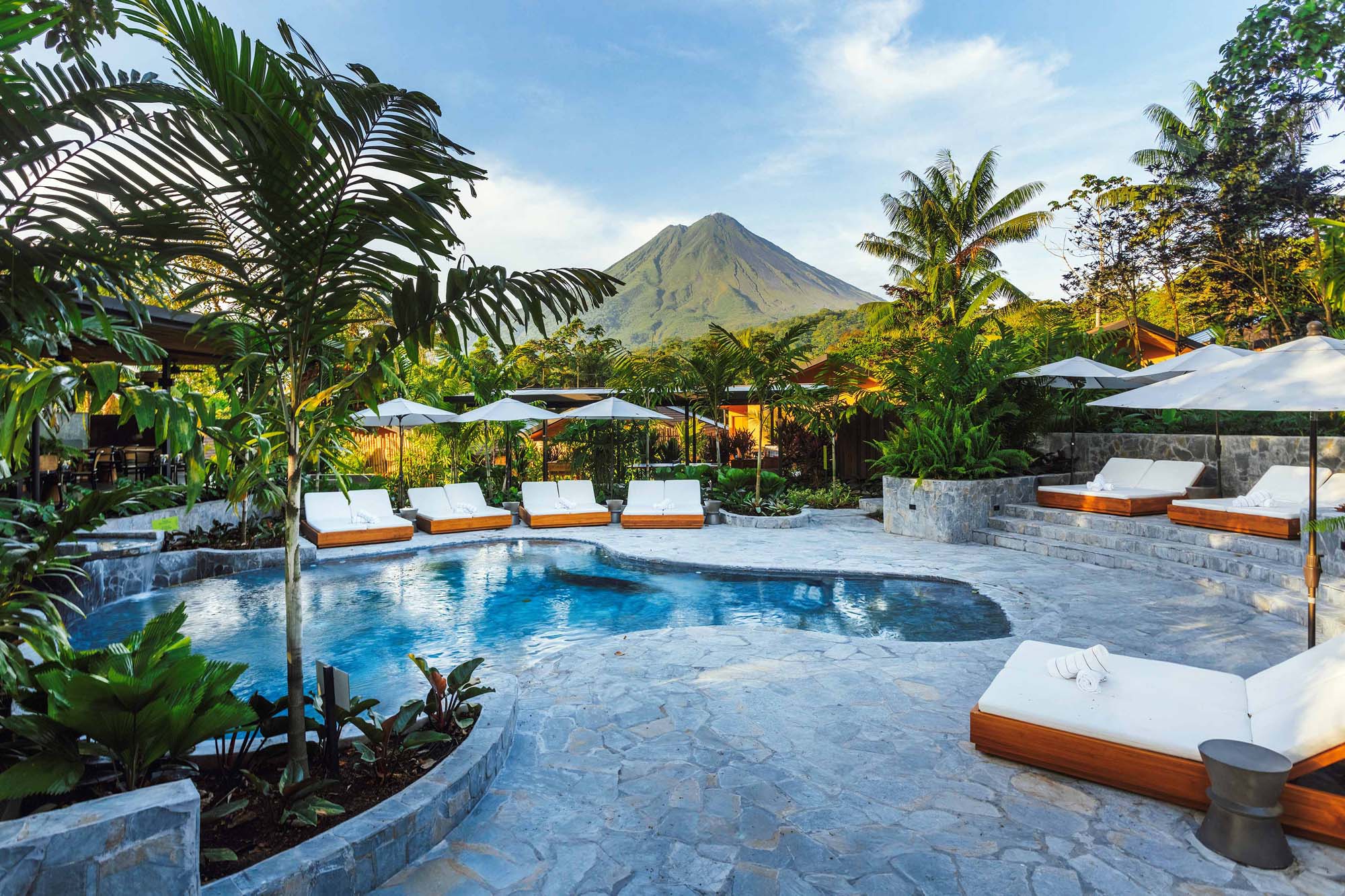
Costa Rica has no shortage of hotels calling themselves eco-friendly. Some go far beyond bamboo straws and towel-reuse cards: they protect hundreds or thousands of acres of rainforest, generate their own power, hire almost entirely from the town down the road, and fund conservation work that continues whether or not a guest is there to see it. Others use "sustainable" in the same paragraph as "infinity pool" and hope nobody checks.
We check. The eleven properties below range from a raft-access lodge with no road in at all to a 28-bungalow base a fifteen-minute walk from downtown Monteverde. They're not interchangeable, and their sustainability credentials aren't equal either: a couple hold Costa Rica's official CST Elite certification, one runs on nothing but solar and micro-hydro with zero diesel backup, and at least one leans more on "eco-friendly generator" language than anything you could verify. We'd rather you know that up front, then you can decide for yourself.
How we chose these properties
Every lodge here had to clear more than one bar. We looked at:
Habitat protection. Does the property hold or protect land beyond its own footprint, and how much? Lapa Rios' 1,000-acre reserve is under a conservation easement with The Nature Conservancy. Playa Cativo's 1,000 acres border Piedras Blancas National Park directly.
Energy, water, and waste systems. "Solar-powered" can mean a fully off-grid property (El Remanso: 100% solar and micro-hydro, no diesel generator at all) or a property on the national grid that happens to note the grid itself runs 98.6% renewable (Nayara's three Arenal properties). Both are legitimate, but they're not the same claim, and we've tried to say which is which rather than blur them together.
Local employment and sourcing. Lapa Rios and El Remanso both describe hiring exclusively or almost exclusively from surrounding communities. Where a property gave us a real number, we used it. Where it only said "supports the local community" with nothing behind it, we said that instead.
Recognized certification. Costa Rica's CST (Certificación para la Sostenibilidad Turística) is the government's own five-tier sustainability rating, and it's the one we checked hardest. A few properties here hold it at the top Elite tier. Several others hold no formal third-party certification at all, whatever their marketing copy implies, and we've noted that plainly rather than let a property's own "eco-lodge" branding stand in for verification. For more on what we look for across the region generally, see our responsible travel approach, and for the same standard applied to everyday trip decisions, our guide to sustainable travel across Latin America.
Wildlife practices and access. Camera-trap monitoring, named research partnerships, or guided access that doesn't disturb the animals it's selling, rather than "monkey encounters" as a bookable activity.
Relationship with the surrounding community. Named partnerships (a school, a recycling cooperative, an Indigenous cultural center) beat "gives back" as a phrase.
What guests get access to. A remote lodge is only worth the transfer time if it opens up something a closer, easier property can't.
Quick comparison
How to combine these lodges in one trip
None of these properties sit close enough together to visit more than two or three in a single trip without losing days to transfers. A few pairings work well logistically. Pacuare Lodge and El Silencio Lodge both sit within roughly 1.5 to 3 hours of San José in different directions, which makes either a strong two- or three-night opener or closer around a longer Costa Rica itinerary rather than a standalone trip. The Osa cluster, Lapa Rios, El Remanso, Playa Cativo, Copa de Arbol, and Cielo Lodge, all share the same access points through Puerto Jiménez or Golfito, so combining two of them usually means one flight in, one boat or short drive between properties, and one flight out, rather than backtracking through San José. Origins Lodge pairs naturally with a Guanacaste beach stay given its position near Liberia. Senda Monteverde and the Arenal-based Nayara properties sit roughly 2.5 to 3 hours apart by road and are commonly combined as a highlands-into-volcano itinerary.
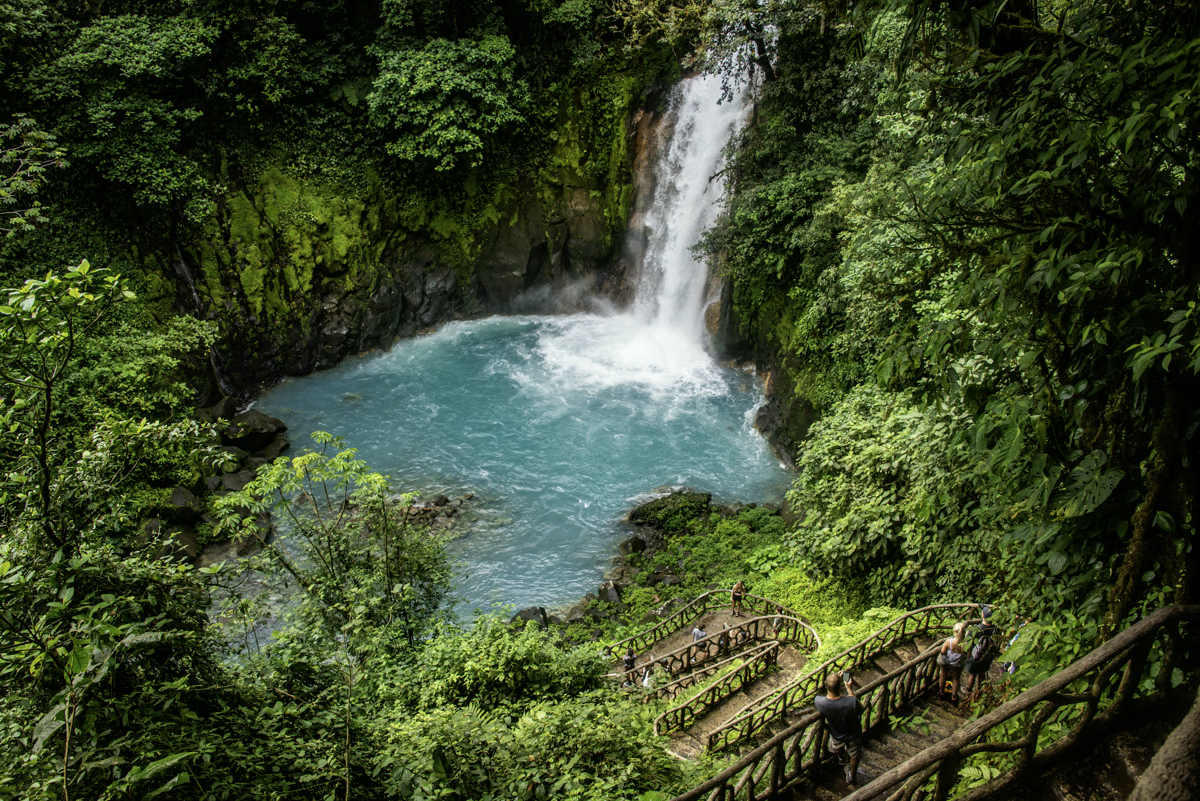
Arenal and the northern lowlands
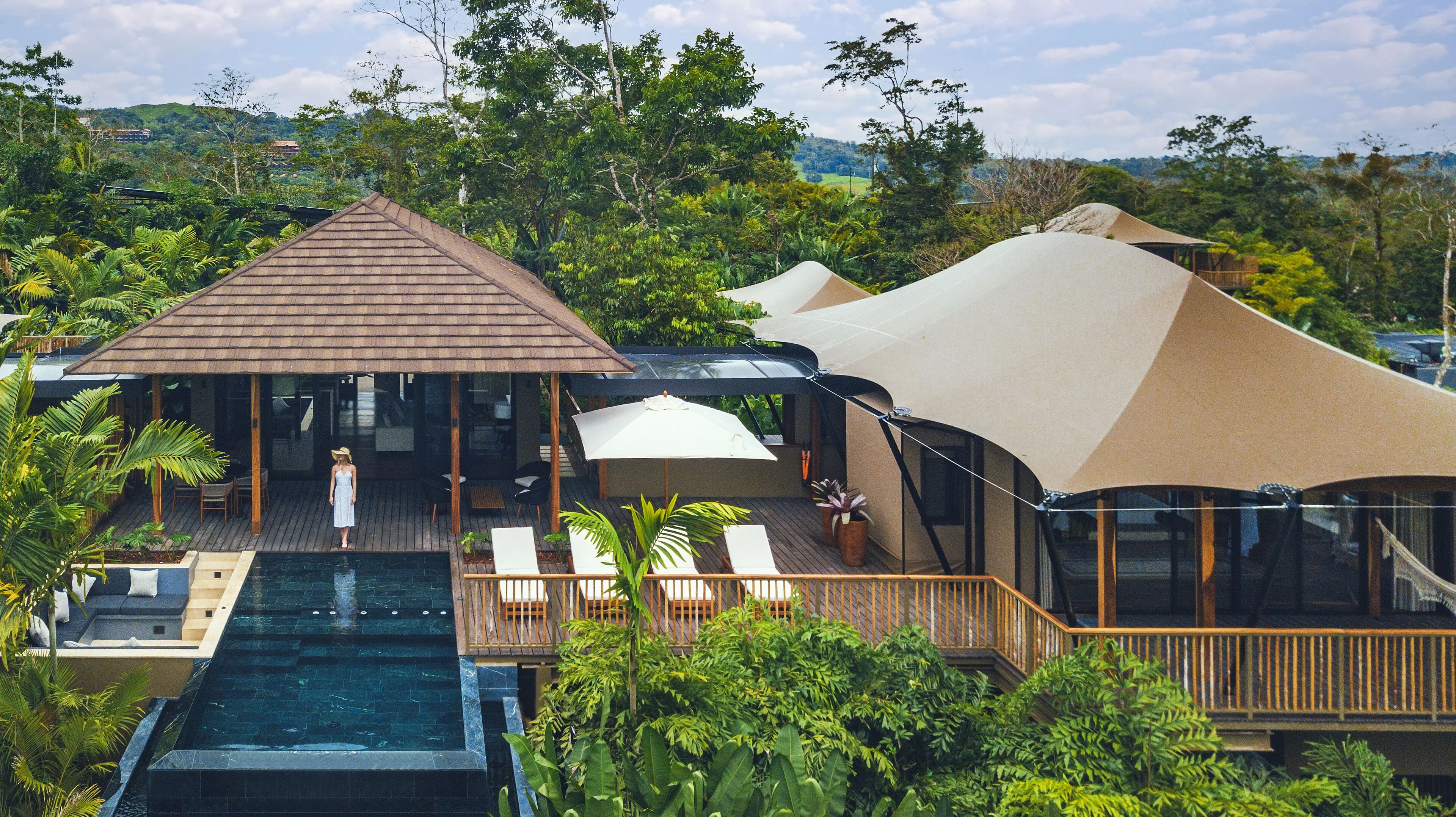
Nayara Springs, Nayara Gardens, and Nayara Tented Camp: adults-only villas and family stays near Arenal
Nayara runs three sister properties on shared grounds at the base of Arenal Volcano, and the trio structure is the actual reason to consider it over a single Arenal resort: Nayara Springs is adults-only, minimum age 18, with 35 teak-and-stone villas built around hot spring-fed plunge pools; Nayara Gardens is the family property; Nayara Tented Camp is glamping-style canvas suites on what used to be cattle pasture.
That pasture detail matters. Nayara has replanted more than 20,000 native trees on the Tented Camp grounds, one of the more ambitious private reforestation efforts we found in this group, and a fact you can check rather than take on faith. The three properties are certified by Green Globe, not by Costa Rica's CST program, and they run on the national grid rather than on-site solar. Nayara's own sustainability materials lean on the fact that Costa Rica's grid was 98.6% renewable in 2025, which is a fair point but a different claim than "we generate our own power," and we'd rather draw that distinction than let it blur.
At a glance: 35 villas at Nayara Springs (Gardens' count is disputed between Nayara's own listings, 44 to 49) | La Fortuna, Arenal | ~3 hrs from San José or Liberia, or ~30-min flight | Springs is adults-only (18+); Gardens and Tented Camp welcome families | Not ideal if you're set on staying somewhere fully off-grid | Allow 3-4 nights
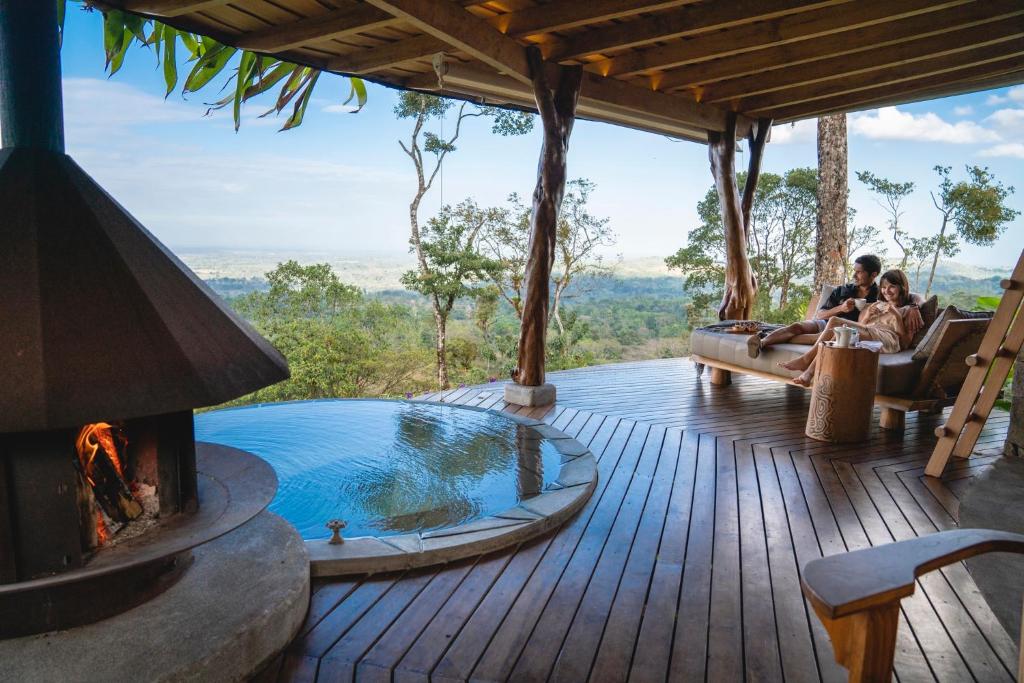
Origins Lodge: an off-circuit rainforest stay near Rio Celeste
Origins sits in Bijagua de Upala, on the foothills between the Tenorio and Miravalles volcanoes near the Nicaraguan border, not in the hills of Alajuela the way its old marketing copy suggested (Alajuela is the province; the property itself is nowhere near Alajuela city). That's the appeal: it's off the standard Arenal-to-Monteverde circuit, and it puts Rio Celeste's turquoise river within easy reach without competing for a room in La Fortuna.
The property runs as two adjoining estates on 45 hectares: Origins Floral, seven lodges aimed at couples, and Origins Astral, seven villas with a kids' club for children up to 15. On the ground, that means solar-heated water, no air conditioning (the elevation does the cooling), vermicomposting, 25 hives of native stingless Melipona bees, and partnerships with Tapir Valley Nature Reserve and the Maleku Indigenous Cultural Center. Origins states it's currently pursuing Blue Flag certification rather than holding it yet, which we're noting rather than rounding up.
At a glance: 14 units across two estates (Floral for couples, Astral for families) | Bijagua de Upala, near Tenorio Volcano | ~2–2.5 hrs from Liberia, ~4.5 hrs from San José by road | Better paired with a Guanacaste coast stay than as a standalone destination | Allow 3-4 nights
Central Highlands: cloud forest and river valley
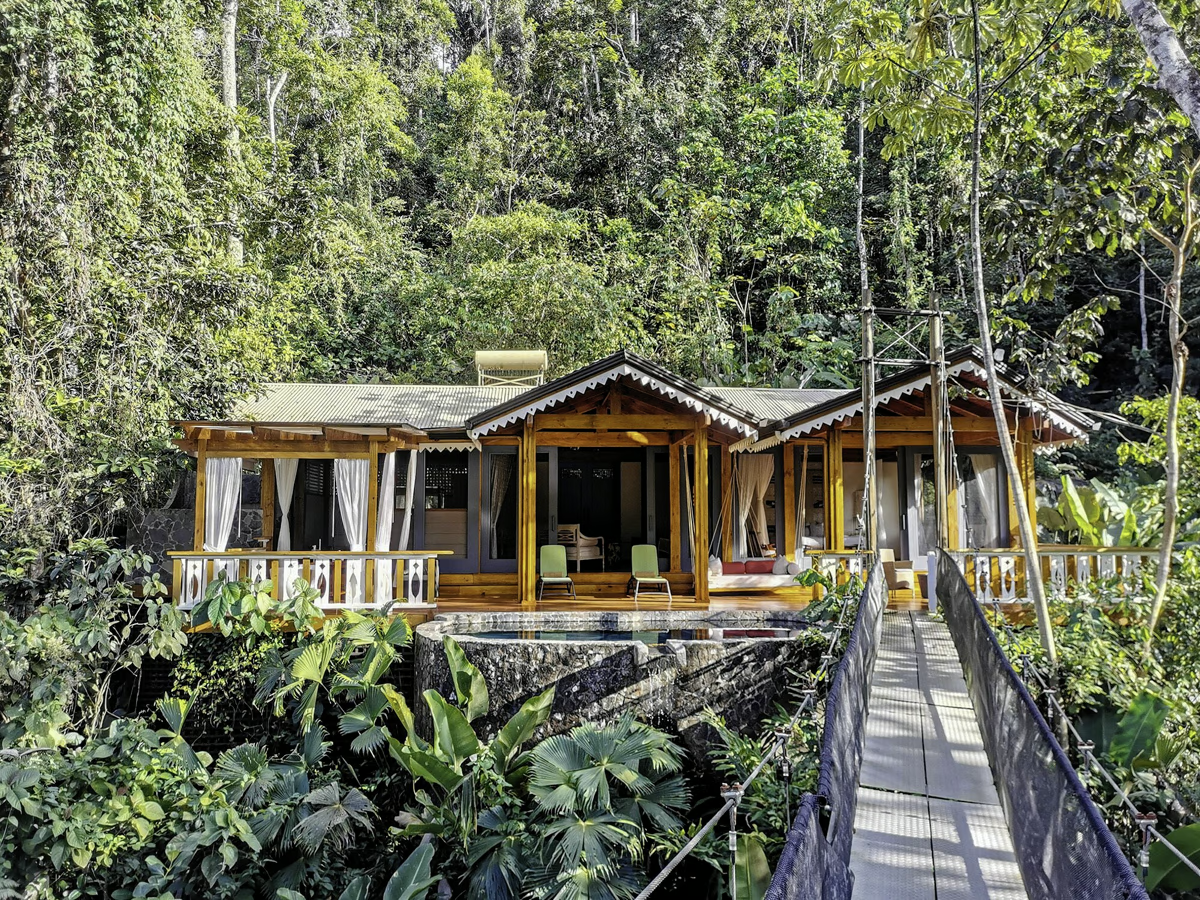
Pacuare Lodge: rainforest immersion on the Pacuare River
Pacuare Lodge turns the journey into part of the stay. Most guests arrive by whitewater raft, following the Pacuare River through forested canyons before reaching the lodge on its own 840-acre reserve in the Talamanca foothills. There's no road in; the alternative to rafting is a 4x4 transfer, or a helicopter if you'd rather skip both.
The lodge states 100% of its on-site power comes from its own solar panels and micro-hydro turbines, water is drawn from a mountain spring and tested regularly, and the property holds Costa Rica's CST Elite rating, awarded and dated by the national tourism institute in January 2024, the clearest certification paper trail of anything on this list. "Project Jaguar," a partnership with Costa Rica's National University, studies and protects jaguars on the reserve, and the lodge's architecture and staffing draw on ties to the Cabécar communities in the region, though Pacuare doesn't publish a specific local-hire percentage the way a couple of the Osa properties do.
Minimum age to stay is 7; rafting in requires 9 and rafting out requires 12, so a family with younger children would use the ground transfer instead. This is one of the strongest choices for travelers who want an active rainforest stay without giving up privacy or good food. Consider it alongside our Luxury Loop: Pacuare to Uvita itinerary, which uses the same access route as a launch point for a longer trip, and see our adventure travel page if the river arrival itself is the draw.
At a glance: 20 suites and villas | Talamanca foothills, near Turrialba | Raft or 4x4, ~2.5–3 hrs from San José | Minimum age 7 (9+ to raft in, 12+ to raft out) | Allow at least 3 nights

El Silencio Lodge: cloud forest and waterfall trails in Bajos del Toro
Bajos del Toro sits cooler and mistier than almost anywhere else on this list, a genuine cloud forest an hour and a half from San José by road rather than a multi-hour transfer. El Silencio protects more than 500 acres on-site, including the micro-basin that feeds the Gorrión River, and states it's diverted more than 160 tons of waste from landfills between 2018 and 2024, a specific, checkable number rather than a general claim.
The lodge advertises Costa Rica's CST Elite rating along with seven Bandera Azul Ecológica (Blue Flag) awards. We tried to confirm the CST claim directly against the government's own certified-entities registry this week and the specific property page returned a 404, so treat it as lodge-stated rather than independently verified by us, which is a different level of confidence than we're able to offer for Senda Monteverde below, where the registry page loaded cleanly. Current energy comes from the national hydroelectric supply, with solar and micro-hydro additions planned under a five-year strategy rather than already in place. Staff are described as more than 95% local, supporting roughly 300 people in the surrounding community.
At a glance: 23 suites and villas | Bajos del Toro cloud forest | ~90 min drive from San José (SJO) | Family-friendly, villas sleep up to two adults and two children | Allow 3 nights
The Central Pacific coast
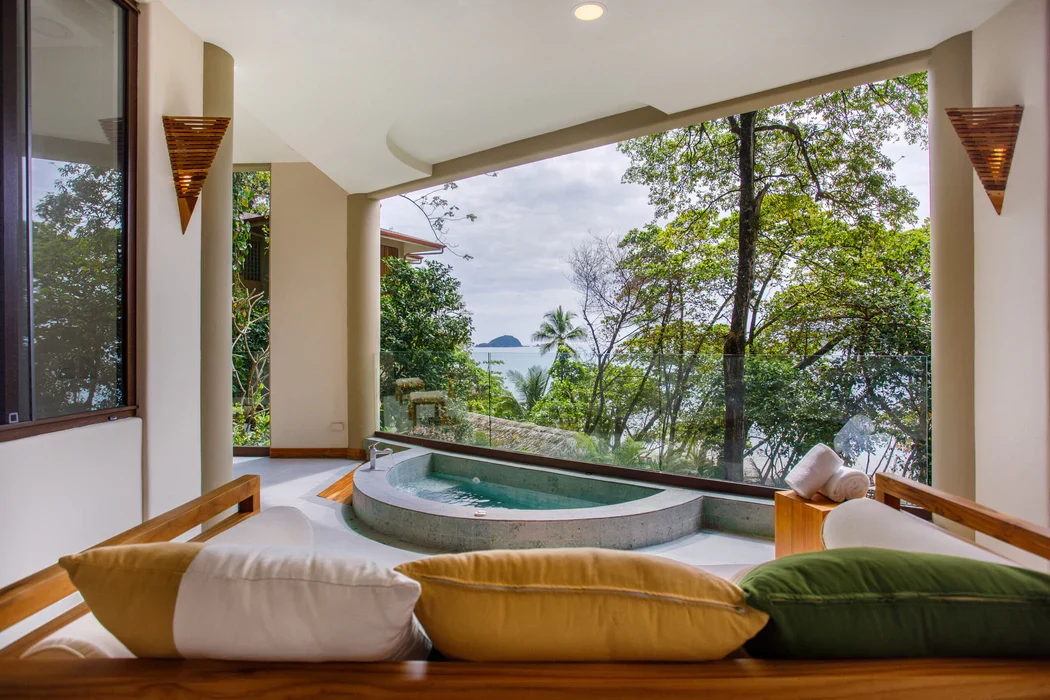
Arenas del Mar: beachfront base for wildlife-minded families in Manuel Antonio
Arenas del Mar sits on the coast at Manuel Antonio with its own stretch of beach and a documented camera-trap program that's recorded pumas, ocelots, pacas, and tamanduas on the property, not just a claim of biodiversity but an actual monitoring log. The property holds a full CST Five Leaves rating, the top tier, along with a five-star Bandera Azul (Blue Flag) rating for beach and energy standards.
Where this one is thinner: Arenas del Mar doesn't publish its energy source, a described waste or water treatment system, or a reforestation figure the way several of the Osa and highlands properties do. What it does specify is a hydroponic vegetable garden using roughly 10% less water than soil growing, participation in a "Dock-to-Dish" seafood sourcing program, and the elimination of single-use plastic bottles, straws, and bags. It's a strong pick for a family that wants beach and rainforest in the same stay without the multi-hour transfer of the Osa properties, less so for a traveler prioritizing energy transparency above all else.
At a glance: 37 suites (a couple of Arenas del Mar's own pages say 38; worth confirming the current count before quoting it) | Manuel Antonio, Central Pacific | Road from Quepos/San José or flight to the Quepos airstrip | No minimum age; actively markets family packages | Allow 3+ nights
Osa Peninsula and Golfo Dulce
The Osa Peninsula and the waters of Golfo Dulce hold five of the eleven properties here, more than any other region, and that's not a coincidence: National Geographic has called the Osa "the most biologically intense place on Earth," and it shows in how these five properties talk about wildlife. For more on what that biodiversity looks like on the ground, see our wildlife destinations guide.

Lapa Rios: conservation and wildlife density on the Osa Peninsula
Lapa Rios protects 1,000 acres under a conservation easement held with The Nature Conservancy, bordering Corcovado National Park directly. Camera traps run through its Jaguar Program have logged more than 80,000 photos documenting 21 large-mammal species on the reserve, which is a stronger wildlife credential than almost anything else on this list, backed by data rather than adjectives. The lodge also funds coral-restoration research through the nonprofit Raising Coral in nearby waters.
On operations: 220 solar panels and 10 nano hydro-turbines with battery storage, salt-based (chlorine-free) pool purification, septic wastewater treatment with metered consumption, and a stated 100% local hiring rate, with most management roles held by women. Lapa Rios holds CST certification, though the property doesn't publish which tier, so we're not claiming Elite status for it the way we can for Pacuare and Senda Monteverde. Effective minimum age is around 6, based on the property's own language about "adventurous, nature-loving children."
At a glance: 17 suites, villas, and bungalows | Cabo Matapalo, Osa Peninsula | Fly to Puerto Jiménez (~50 min) + 45-min transfer, or ~7-hr drive | Best for serious wildlife travelers | Pairs well with our Wild Southern Pacific itinerary | Allow at least 4 nights

El Remanso: off-grid wilderness on the Osa Peninsula
A short drive from Lapa Rios on the same peninsula, El Remanso is smaller and less polished, and that's the point for the traveler it suits. It's the one property in this whole list that states, plainly, it runs 100% off the national grid on solar and micro-hydro with no diesel backup generator at all, drawing water from an on-site spring that's UV-filtered and lab-tested. No bottled water is sold on the property.
Staff are described as exclusively local, and the lodge supports the Puerto Jiménez Community Center and ASCONA, a local group running environmental education and beach cleanups. El Remanso doesn't hold a CST rating, B Corp status, or Rainforest Alliance certification that we could find anywhere, official or third-party, which is a genuine gap next to its operational specifics rather than a minor omission. Room count is listed as 16 on the property's own homepage but as 14 on its About page and in independent coverage; we're going with 14 as the better-corroborated figure but flag it for confirmation before quoting it to a client.
At a glance: 14 rooms (count disputed on the property's own site, ranges to 16) | Cabo Matapalo, Osa Peninsula | Fly to Puerto Jiménez + 45-min 4x4, or ~6-hr drive | Family-friendly | Best for travelers who want genuinely off-grid power, not just the marketing version of it | Allow 3 nights
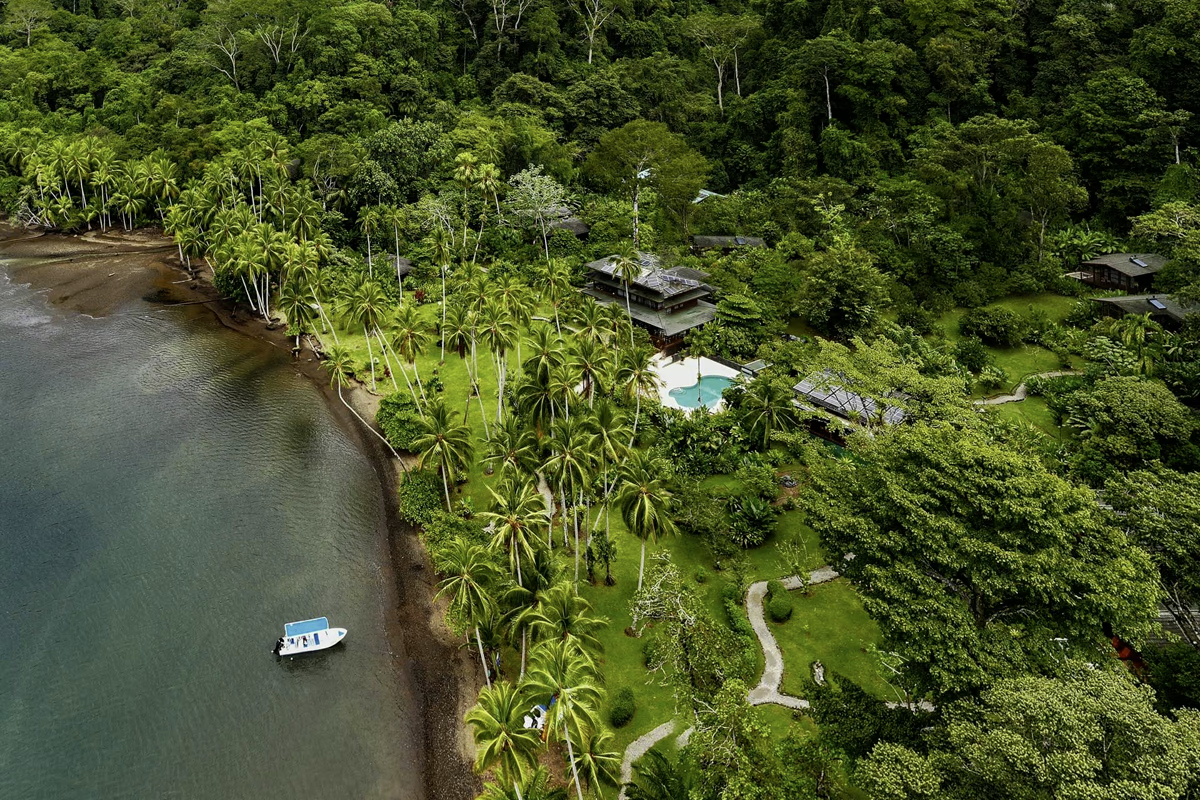
Playa Cativo: boat-access seclusion on Golfo Dulce
Playa Cativo sits where rainforest meets sea on Golfo Dulce, reachable only by a roughly 30-minute boat transfer from either Golfito or Puerto Jiménez airstrip, no road option at all. The 1,000-acre reserve borders Piedras Blancas National Park, and the lodge states its power comes from a hybrid system of on-property hydroelectric (fed by waterfalls and creeks) and solar, plus solar water heating.
A few third-party sources describe Playa Cativo as Rainforest Alliance-verified and Blue Flag certified, but we could not confirm either claim on the property's own site, so treat that specific certification claim as unverified rather than settled fact until the lodge confirms it directly. What is confirmed: an on-site organic farm, biodegradable Costa Rica-made bathroom products, and a minimum age of 5.
At a glance: Room count not published in a single figure across seven room categories, worth a direct question before quoting one | Golfo Dulce, boat-only access (~30 min from Golfito or Puerto Jiménez) | Minimum age 5 | Best for couples or families wanting total seclusion with functioning hybrid power | Allow 4+ nights
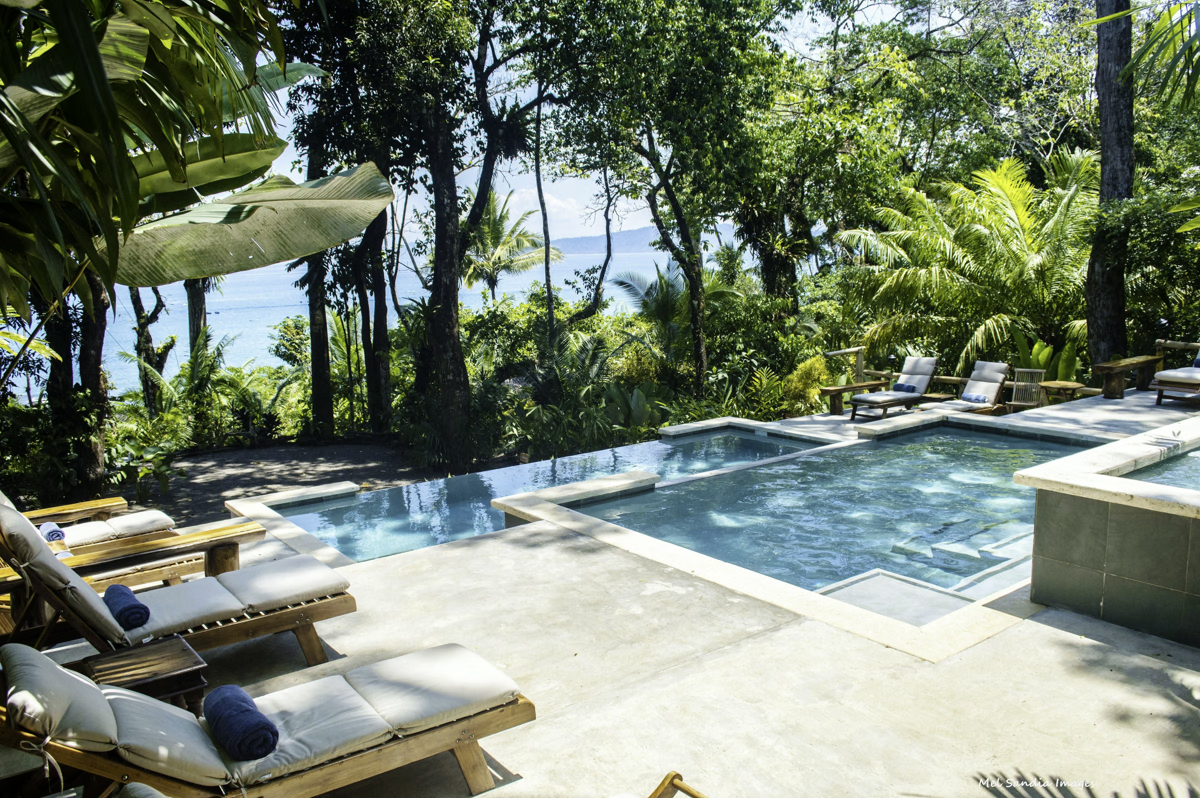
Copa de Arbol: boat-access base for Corcovado, Drake Bay
Copa de Arbol is the one property on this list with no road option whatsoever, boat-only from the Sierpe dock (about an hour through mangroves) or a short flight to the Drake Bay airstrip followed by a brief taxi and boat combination. It protects a 70-acre reserve and sits within easy reach of Corcovado National Park, making it a natural base for a dedicated Corcovado hike.
We'll say plainly what our research turned up: this is the thinnest sustainability documentation of the eleven. The property states its cabins use "recycled materials and reforested wood," which is specific and real, but beyond that its language is largely "eco-friendly backup generator" and "supports local conservation efforts" without a named primary energy source, a described waste system, or a named partner organization. It holds no CST, B Corp, or Rainforest Alliance certification that we could find. Copa de Arbol earns its place here on remoteness and Corcovado access, not on the depth of its sustainability record, and a traveler prioritizing verified sustainability credentials above all else should look at Lapa Rios or El Remanso instead.
At a glance: Room count disputed across the property's own pages, ranging 8 to 11, best-supported figure is 10 | Drake Bay | Boat only, no road access | Family-friendly | Better for a Corcovado-focused stay than for sustainability purists | Allow 3+ nights
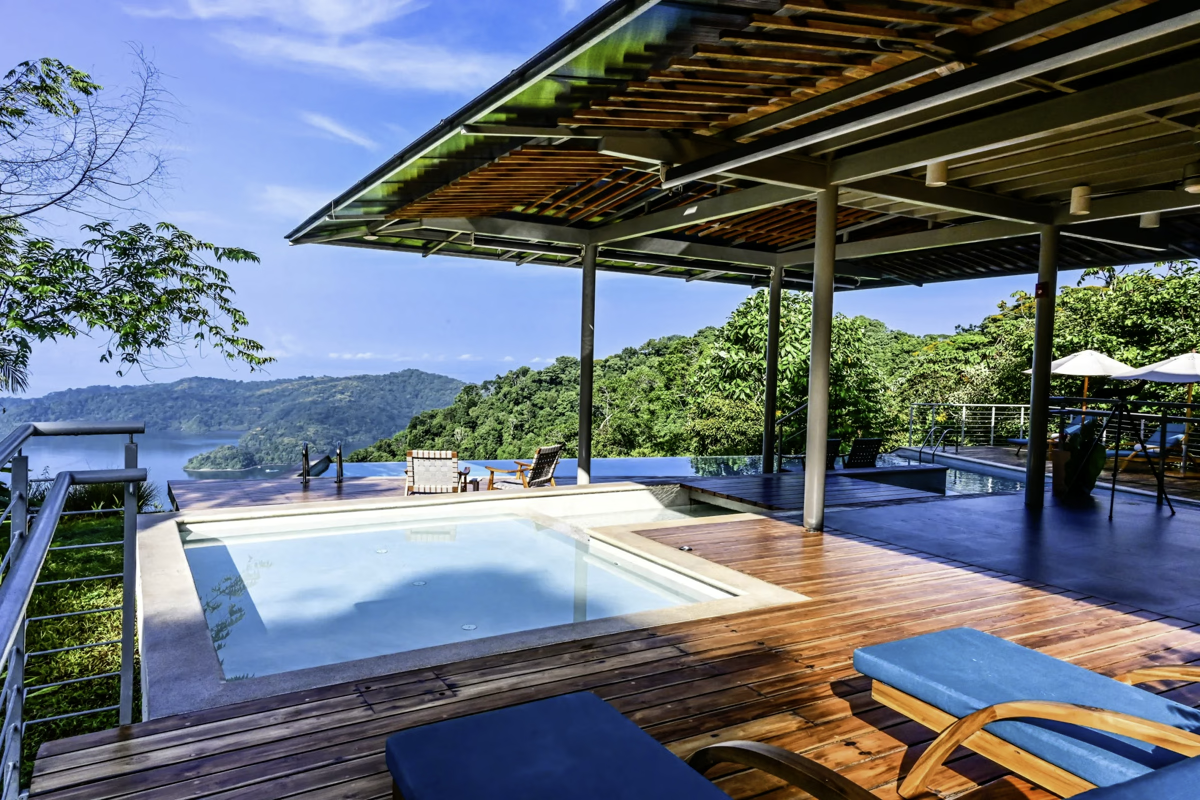
Cielo Lodge: six suites above Golfo Dulce
Cielo Lodge is the smallest and most private property on this list: six one-bedroom canopy suites on 114 hectares above Golfo Dulce, of which 102 hectares are enrolled in Costa Rica's national Fonafifo forest-protection payment program, a real, checkable conservation mechanism rather than a marketing phrase. It was named to Condé Nast Traveler's 2026 roundup of best hotels in Costa Rica, which we independently confirmed through the lodge's own press page and a corroborating third-party recap, since we couldn't load the Condé Nast page itself directly.
What sets Cielo apart from the other Osa-area lodges here is how specific its research partnerships are: an audio biodiversity study tracking jungle species from the Osa to Panama, coral-reef restoration in Golfo Dulce run with the University of Costa Rica, and jaguar-tracking work with Osa Conservation. Power comes from solar and a small micro-hydro system, wastewater runs through constructed-wetland bio-filtration before leach fields, and the lodge's timber came from 13 permitted fallen trees rather than new logging. Despite marketing itself as an eco-lodge, Cielo doesn't hold a CST, B Corp, or Rainforest Alliance certification that we could locate, worth knowing next to its otherwise well-documented operations.
At a glance: 6 suites | Above Golfo Dulce, Osa Peninsula | Fly to Golfito (50 min) + 30-min drive, or ~40-min boat from Puerto Jiménez | Minimum age 10 | Best for privacy-focused travelers and birders | Allow 2–3 nights
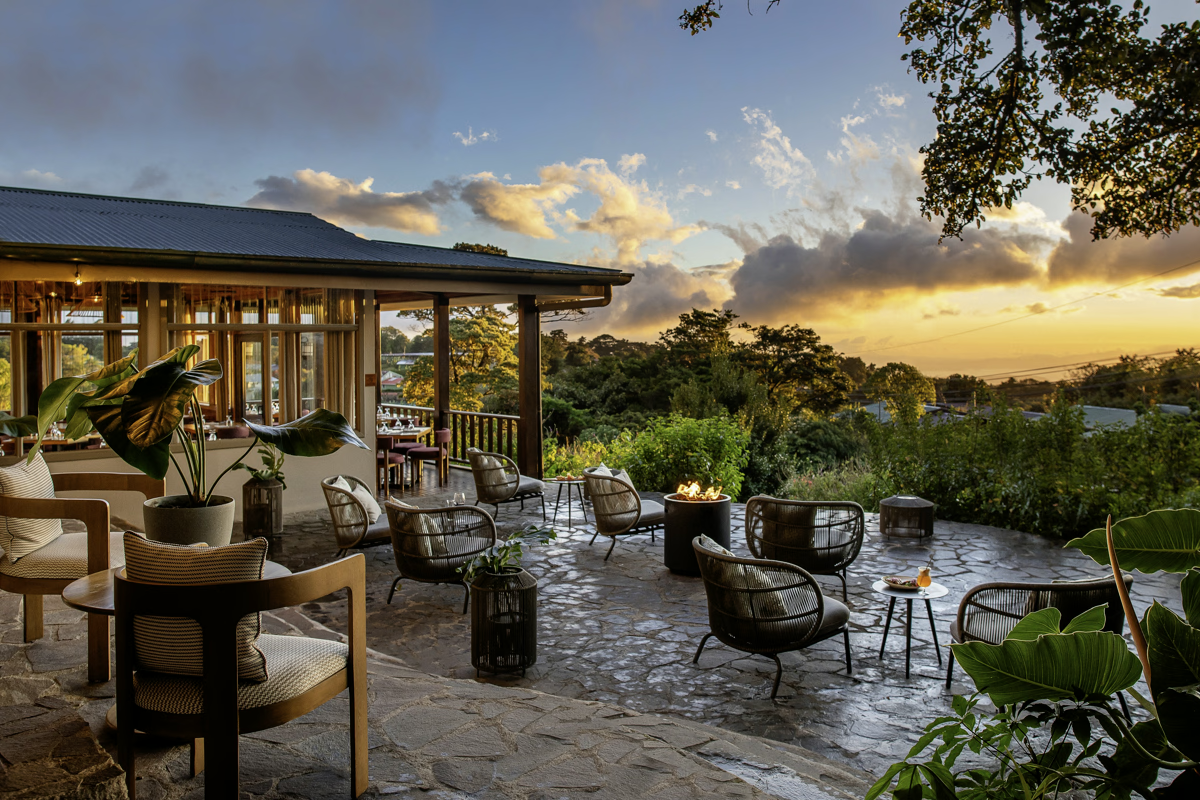
Monteverde
Senda Monteverde: a refined, certified base for the cloud forest
Senda Monteverde is the property with the cleanest certification paper trail of anything on this list. It holds Costa Rica's CST at Nivel Élite, the top tier, certified May 19, 2026 and valid through May 19, 2029, which we confirmed directly against the government's own certified-entities registry rather than taking the lodge's word for it. That's a meaningfully stronger claim than "eco-luxury," and it's the one property here where we can say the top-tier government certification is dated and verified, not just stated.
Senda is part of the Cayuga Collection, whose properties have collectively drawn National Geographic World Legacy recognition, and it's replanted more than 5,500 native plants and trees on land that sat neglected for close to a decade before Cayuga took it over. It sources organic produce, hormone-free chicken, and responsibly caught fish directly from local farmers and fishermen, and staff volunteer with the Monteverde Forest Clean Up youth program. Guests get complimentary access to the neighboring Aguti Wildlife Reserve, and it's a fifteen-minute walk to Santa Elena town, which matters more here than it sounds: Monteverde's better-known lodges tend to trade town access for isolation, and Senda doesn't ask you to choose. For a wildlife-specific angle on the same cloud forest, see our birding lodges guide.
At a glance: 28 bungalows | Monteverde/Santa Elena | ~2.5 hrs from San José or Liberia | Family-friendly | Best for cloud forest immersion without sacrificing access to town | Allow 2 nights
Frequently asked questions
What makes a hotel an "ecolodge" rather than just a hotel that says it's eco-friendly?
In Costa Rica, the clearest signal is third-party certification, specifically CST (Certificación para la Sostenibilidad Turística), the government's own five-tier rating system. A property that holds CST Elite, like Pacuare Lodge or Senda Monteverde, has been independently verified. A property that only uses the word "eco-friendly" in its own marketing, with no certification behind it, like a couple of the properties on this list, may still run a genuinely low-impact operation, but you're taking their word for it rather than a verifier's.
Which of these lodges is best for serious wildlife travelers?
Lapa Rios, on the strength of its documented 21-species camera-trap data and its position bordering Corcovado National Park. El Remanso and Cielo Lodge, both nearby on the Osa Peninsula, are close seconds, particularly for birders.
Are these ecolodges good for a family trip, or mostly for couples?
It varies by property, not uniformly across the list. Nayara Springs, Playa Cativo (minimum age 5), and Cielo Lodge (minimum age 10) each have age minimums that rule out young children. Origins Astral, El Silencio, Arenas del Mar, and Senda Monteverde are explicitly set up for families, with kids' programming in a couple of cases. Pacuare Lodge sits in between: children are welcome from age 7, but rafting in requires age 9 and rafting out requires 12.
Do I need a rental car to reach these lodges?
For most of them, no, and in a few cases a rental car wouldn't help. Pacuare Lodge, Playa Cativo, and Copa de Arbol have no road access at all; you arrive by raft, boat, or a combination of flight and boat. Lapa Rios, El Remanso, and Cielo Lodge are typically reached by a short domestic flight followed by a ground or water transfer arranged by the lodge. Origins Lodge, El Silencio, Senda Monteverde, and the Nayara properties are all reachable by road, and a private transfer is usually more comfortable than self-driving given how rough the final stretch can get.
How many nights should I plan at a remote ecolodge like these?
Two nights is the minimum to make the transfer worthwhile at most of these properties; three or more makes sense at the more remote, activity-dense lodges like Pacuare, Lapa Rios, El Remanso, and Playa Cativo, where a single night barely covers the arrival logistics. The closer-in properties, Senda Monteverde, El Silencio, Origins, tend to work well as two-night stops within a longer, multi-region trip.
Planning a trip around these lodges
Costa Rica's best ecolodges are spread across river valleys, cloud forests, volcanic lowlands, and the Osa Peninsula, and choosing which hotel to book is only part of the planning. Transfer times, seasonal rainfall, domestic flight schedules, and boat conditions on Golfo Dulce all affect how a multi-stop trip plays out, and getting the order wrong costs a day you don't get back.
We've stayed at or sent clients to most of the properties above, and we build itineraries around the region a traveler most wants to experience first, then choose the lodges that fit their priorities: serious wildlife, a quiet stay as a couple, an active family week, or a property with a conservation program worth caring about beyond the stay itself. Tell us what you're picturing and we'll help you put the pieces together.


