

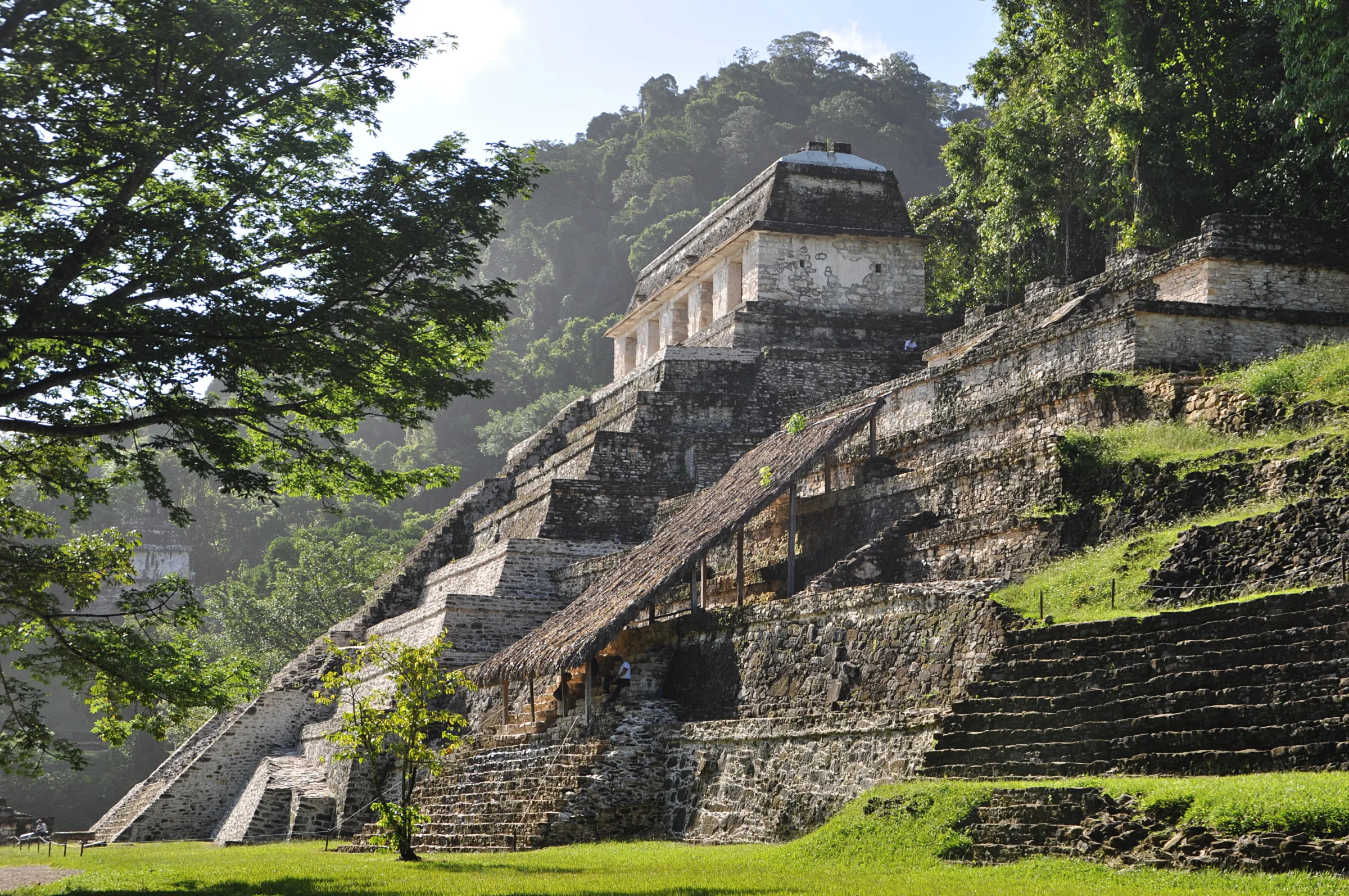
Palenque lies at the northern edge of the Chiapas highlands where forest-covered hills descend toward the Gulf lowlands. The archaeological city reached its height during the Classic Maya period and is known for refined architecture, carved inscriptions, royal tombs, and a landscape integrated with streams and terraces. Much of the ancient city remains beneath forest, and the surrounding region contains waterfalls, rivers, wildlife habitat, and communities connected to both highland and lowland Chiapas.
At a glance
| Best for | Maya archaeology, rainforest, inscriptions, waterfalls, wildlife, and regional history |
|---|---|
| Don't miss | The archaeological zone, the site museum, an early forest walk, and one waterfall or river excursion |
| Recommended stay | 3 to 5 nights |
| Best area to stay | The hotel zone between town and the archaeological park |
| Pairs well with | San Cristóbal de las Casas, Campeche, the Yucatán Peninsula, and Guatemala's Petén region |
| Closest airport | Villahermosa International Airport (VSA), with limited regional service closer to Palenque when operating |
| Best time to visit | November through April for somewhat drier and cooler conditions |
| Getting around | Private transfers, authorized guides, and guided nature excursions |
| Budget | $$ to $$$ |
Why stay in Palenque?
Palenque's architecture is smaller in scale than Teotihuacán or Chichén Itzá but exceptionally sophisticated. The Palace, Temple of the Inscriptions, Cross Group, aqueduct, and funerary monuments reveal a city defined by dynastic politics, water management, ritual, and written history.
The tomb of ruler K'inich Janaab' Pakal transformed understanding of Maya kingship and funerary architecture. Original objects and reproductions in the site museum provide essential context, even when access to individual structures changes for conservation.
The forest is not simply a backdrop. Streams, ravines, limestone, rainfall, and tropical vegetation influenced the settlement's architecture and long-term preservation. Early walks may reveal monkeys, toucans, insects, and other wildlife, but sightings are unpredictable.
Waterfall areas such as Roberto Barrios, Misol-Há, and Agua Azul differ in scale, water color, crowd levels, road time, and swimming conditions. Heavy rain can change clarity and current, making selection on the day more sensible than promising a specific appearance.
Palenque also works as a transition between Chiapas and the Yucatán Peninsula. Long road routes connect toward Campeche, Calakmul, and the Gulf, while Guatemala's Petén region can be reached through more complex border and river itineraries.
Our take: stay close to the archaeological park and visit at opening with a specialist guide. One focused ruin day and one nature day provide a stronger experience than repeatedly moving between distant waterfalls.
Is Palenque a good fit?
- Want detailed Maya history and inscriptions.
- Enjoy archaeology surrounded by tropical forest.
- Are interested in waterfalls, rivers, and wildlife.
- Can manage heat, humidity, rain, and uneven paths.
- Want to connect Chiapas with the Yucatán Peninsula or Guatemala.
- Prefer a small regional hotel to a major luxury resort.
Chichén Itzá is more monumental and heavily visited, while Palenque provides denser forest, more intimate architecture, and exceptional written history. San Cristóbal adds highland culture and textiles rather than lowland archaeology.
Best things to do
Explore the archaeological zone early
An early private visit provides cooler conditions and quieter paths. A specialist guide can interpret inscriptions, royal history, architecture, and conservation without reducing the site to a short circuit of famous buildings.
Visit the Alberto Ruz Lhuillier Site Museum
The museum preserves sculpture, ceramics, inscriptions, funerary objects, and interpretation connected to the ancient city. Opening schedules should be confirmed because access can change.
Walk through the forest
Authorized paths around the archaeological park reveal streams, secondary structures, vegetation, and wildlife habitat. Conditions can be muddy and slippery after rain.
Visit Roberto Barrios
A series of cascades and pools lies south of town near a local community. Water levels, current, and access vary, so visits should use trusted guides and follow on-site safety advice.
See Misol-Há
The tall single-drop waterfall is reached by road toward San Cristóbal. Its appearance changes with rainfall, and paths behind or near the water may close when surfaces are unsafe.
Travel toward Agua Azul
The river forms a long series of limestone cascades. Water color depends on sediment and recent rain, and the journey is substantial enough to be combined carefully with onward travel.
Learn about Maya writing and kingship
A scholar-led or specialist archaeological visit can focus on glyphs, calendars, dynastic records, and the political relationships revealed through Palenque's monuments.
Listen for wildlife at dawn
Forest hotels and early excursions may reveal howler monkeys, toucans, parrots, and insects before daytime heat increases. Wildlife should be observed without feeding or approaching.


Where to stay
Stay along the road between Palenque town and the archaeological zone for forest surroundings and the shortest transfer to the ruins. This area contains the region's strongest resorts and small boutique properties.
Stay in Palenque town for restaurants, transport services, and lower-cost hotels. The setting is more urban and hot, with less forest immediately around the room.
Stay at a remote nature property only when the lodge's excursions are the main purpose. Road quality, dining, and communication should be checked before committing to several nights.
We prefer the archaeological hotel zone because it allows an early park arrival and quiet afternoons in gardens or pools after touring.
Our favorite hotels
Quinta Chanabnal
Quinta Chanabnal has eight suites in a garden property approximately three kilometers from the archaeological zone. The property has architecture informed by Classic Maya design, specialist cultural knowledge, and a small room count.
Chan-Kah Resort Village
Chan-Kah has approximately 80 rooms and casitas across 50 acres of forested grounds near the park. The property has large lagoon-style pools and extensive gardens.
Hotel Villa Mercedes Palenque
Villa Mercedes has 92 rooms on landscaped grounds close to the archaeological road. Two pools, a spa, and straightforward family categories provide more conventional resort facilities than the region's tiny boutique hotels.
Best time to visit
November through April is generally drier and somewhat cooler, although Palenque remains hot and humid. Easter and winter holidays bring heavier visitor numbers.
May through October is wetter, with intense rain, higher rivers, and greener forest. Waterfalls may be more powerful but less clear, and road journeys can take longer.
Pair it with
- San Cristóbal de las Casas for highland Maya cultures, textiles, and a cool climate.
- Campeche for a fortified colonial city and a route toward Calakmul.
- Mérida and Valladolid for cenotes, Yucatecan culture, and additional Maya sites.
- Guatemala's Petén region for Tikal and a cross-border Maya itinerary.
Getting there
Villahermosa is the most reliable major airport gateway and is connected to Palenque by road. Regional air service closer to Palenque can change, so the itinerary should not depend on it unless the flight is confirmed.
Approximate travel times:
- Villahermosa Airport to Palenque: 2 to 2.5 hours
- Palenque town to the archaeological zone: 20 to 30 minutes
- Palenque to San Cristóbal: 5.5 to 7 hours
- Palenque to Campeche: 5.5 to 7 hours
- Palenque to Roberto Barrios: 45 to 75 minutes
- Palenque to Agua Azul: 1.5 to 2.5 hours
Road conditions, rain, and local traffic can alter every overland route. We avoid tight onward connections and keep waterfall plans flexible until current conditions are known.


Frequently asked questions
How many nights should I stay in Palenque?
Three nights provide two full days for the archaeological zone and one nature excursion. Four or five nights allow slower wildlife, waterfalls, or a specialist archaeological focus.
What time should I visit the ruins?
Arrive at opening for cooler temperatures, better wildlife activity, and fewer visitors. Confirm current entry rules and museum hours before the day.
Can I climb the temples?
Access changes according to conservation and safety decisions. Follow current signs and staff instructions and do not assume that buildings shown in older photographs remain open.
Is Palenque suitable for families?
Yes. The ruins, forest, pools, monkeys, and waterfalls can be engaging for families. Heat, slippery paths, and long road days require a moderate schedule.
Which waterfall is best?
Roberto Barrios is closer and community-based, Misol-Há is a dramatic single fall, and Agua Azul is a larger cascade system. Water and road conditions should determine the final choice.
Are mosquitoes a problem?
Insects are part of the tropical environment. Lightweight long clothing, suitable repellent, and closed shoes for forest walks are useful, particularly around dawn and after rain.
Can I travel directly from Palenque to Campeche?
Yes by private road transfer, but the journey is long. It works best as part of a route toward Calakmul or the Yucatán rather than as a same-day sightseeing transfer.
What should I pack?
Bring breathable clothing, rain protection, sun protection, insect repellent, and shoes with grip. A dry change of clothes is useful after waterfall or forest excursions.


