

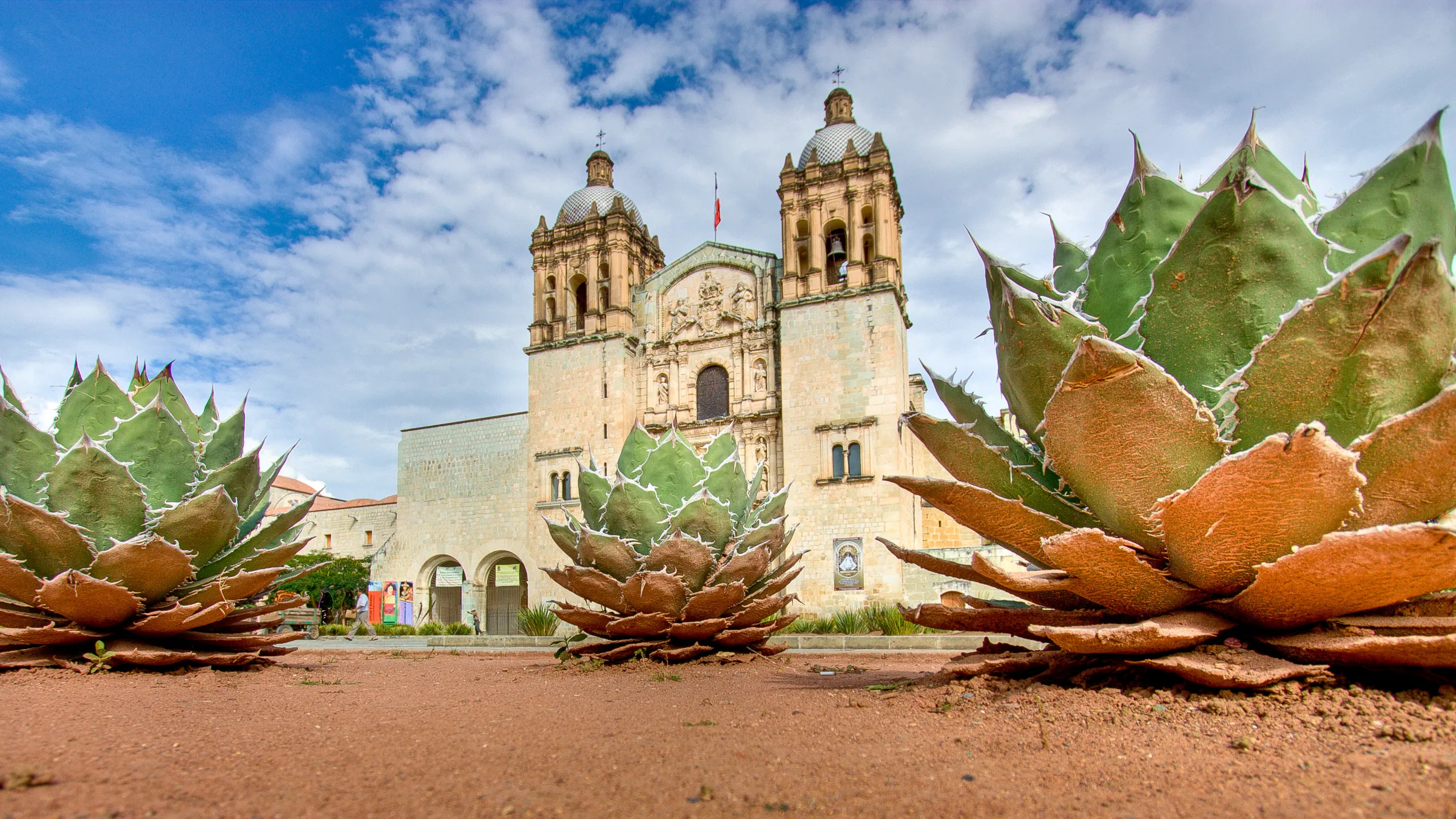
Oaxaca de Juárez lies in a high valley surrounded by mountains and communities with distinct craft, food, and festival traditions. The compact historic center contains Santo Domingo, markets, museums, courtyards, and streets lined with stone buildings, while Monte Albán rises above the valley to the west. Nearby villages specialize in weaving, pottery, woodcarving, agave cultivation, food, and market trade, but these traditions are living economies rather than a collection of demonstrations arranged for visitors.
At a glance
| Best for | Food, archaeology, textiles, ceramics, agave heritage, markets, art, and festivals |
|---|---|
| Don't miss | Santo Domingo, Monte Albán, the markets, an agave heritage visit, and at least one artisan community |
| Recommended stay | 4 to 6 nights |
| Best area to stay | The historic center |
| Pairs well with | Puerto Escondido, Mexico City, San Cristóbal de las Casas, and Puebla |
| Closest airport | Oaxaca International Airport (OAX) |
| Best time to visit | October through April for drier weather, with major cultural events at several points throughout the year |
| Getting around | Private transfers, guided walks, and carefully planned valley excursions |
| Budget | $$ to $$$$ |
Why stay in Oaxaca?
Oaxaca's cuisine reflects maize, chile, beans, herbs, cacao, agave, insects, fruits, and techniques maintained across many communities. Markets and home kitchens are as important as formal restaurants, and no single dish or agricultural tradition represents the entire state.
Monte Albán was one of Mesoamerica's earliest major urban centers. Its terraces, plazas, tombs, carved monuments, and views across the valley provide essential context for the region's Zapotec history. Mitla adds a later architectural tradition known for intricate stone mosaics and its continuing relationship with the nearby town.
Craft traditions vary by community and family. Teotitlán del Valle is associated with wool weaving, San Bartolo Coyotepec with black pottery, Santa María Atzompa with ceramics, and communities around Ocotlán with several forms of folk art. Direct workshop visits allow travelers to understand materials, time, pricing, and innovation.
Agave cultivation and traditional processing have deep agricultural and cultural importance in Oaxaca. A responsible educational visit focuses on agave species, cultivation cycles, roasting methods, water use, labor, and the environmental pressures created by global demand, without centering consumption.
Oaxaca's festivals bring deep local participation and intense visitor demand. Guelaguetza, Día de Muertos, Holy Week, and December celebrations differ in meaning and scale. Accommodation and guiding should be booked early, and travelers should avoid treating religious or community rituals as staged entertainment.
Our take: spend at least two full days in the city and divide valley touring across separate days. The region becomes far more meaningful when a few workshops and food experiences are explored in depth rather than visited as a shopping circuit.
Is Oaxaca a good fit?
- Plan travel around food, archaeology, craft, or markets.
- Want direct contact with artists and producers.
- Enjoy walkable historic centers and courtyard hotels.
- Are interested in Indigenous cultures as contemporary communities.
- Want a city that pairs naturally with the Pacific coast.
- Can allow several days for surrounding valleys and villages.
Mexico City has far greater museum scale, while Oaxaca provides deeper regional continuity between food, archaeology, craft, and community life. San Cristóbal is cooler and more mountainous, with a different mix of Maya cultures and landscapes.
Best things to do
Explore Santo Domingo and its cultural complex
The church, former convent, museum, and ethnobotanical garden occupy one of the city's most important architectural sites. Garden visits require scheduled entry and explain the relationship between plants and Oaxacan cultures.
Visit Monte Albán
A private guide can interpret the city's development, carved monuments, tombs, political reach, and views across the three valleys. Early departures provide cooler conditions and quieter plazas.
Walk through the markets
Benito Juárez, 20 de Noviembre, Central de Abastos, and neighborhood markets serve different purposes. A food guide can introduce ingredients and vendors without turning the visit into a rapid sampling exercise.
Learn about agave cultivation and traditional processing
Visit a community-led farm or educational workshop to examine agave species, earth ovens, cultivation timelines, land stewardship, replanting, and fair compensation. The experience should center agriculture and cultural history.
Meet textile artists in Teotitlán del Valle
Family workshops can demonstrate carding, spinning, natural dyes, and weaving while explaining how designs and commercial markets have changed over time.
Visit pottery communities
San Bartolo Coyotepec, Atzompa, and other villages produce distinct forms using different clays, firing methods, and decorative traditions. Direct purchases support the makers and clarify provenance.
Explore Mitla and the eastern valley
Mitla's geometric stone mosaics, church, tombs, and living town complement the monumental scale of Monte Albán. The day can include a market, producer, or landscape stop without attempting every eastern-valley attraction.
Cook with a local expert
A market-to-kitchen experience can examine maize varieties, chiles, herbs, grinding, sauces, and communal cooking. Small groups and home kitchens generally provide more depth than demonstration-only classes.


Where to stay
Stay within the historic center for Santo Domingo, restaurants, galleries, markets, and evening walks. Northern blocks around Santo Domingo feel more polished, while areas closer to the main markets provide greater street activity.
Stay east or north of the tightest central streets for quieter nights and larger contemporary rooms. The tradeoff is a slightly longer walk or short transfer to the Zócalo.
Stay in a valley hacienda or rural property only as an extension. The strongest first itinerary keeps the city as the primary base and uses private day excursions for villages and archaeology.
Historic-center hotels range from highly traditional former convents to minimal contemporary buildings. Courtyard orientation, stairs, air-conditioning, and street noise should be checked by room category.
Our favorite hotels
Otro Oaxaca
Otro Oaxaca has 16 rooms in a contemporary brick and earth-toned building one block from Santo Domingo. The property has a rooftop pool, underground spa, and local design.
Quinta Real Oaxaca
Quinta Real has 91 rooms in the former convent of Santa Catalina de Siena. The property has large courtyards, frescoes, a central pool, and immediate historic-center access.
Escondido Oaxaca
Escondido Oaxaca has 12 rooms in a restored central house connected to a contemporary rear building. The small scale, rooftop pool, and Grupo Habita design suit couples who value architecture over extensive facilities.
Casa Oaxaca
Casa Oaxaca has seven rooms in a quiet house near Santo Domingo. The property has tiny scale and connection to one of the city's established restaurants.
Best time to visit
October through April is generally dry, with warm days and cool evenings. October and November bring high demand around Día de Muertos, while December has major local celebrations and holiday travel.
May is hot before summer rains. June through September brings afternoon storms, green valleys, and the Guelaguetza season in July. Rain can affect mountain roads but rarely prevents a full city day.
Pair it with
- Puerto Escondido for Pacific beaches, design hotels, surfing, and seafood.
- Mexico City for major museums, art, and international connections.
- San Cristóbal de las Casas for Maya communities, highland landscapes, and a cooler climate.
- Puebla for Talavera, Baroque architecture, and another major regional cuisine.
Getting there
Oaxaca International Airport receives flights from Mexico City and selected domestic and international gateways. The historic center is close to the airport, while valley excursions extend east, south, and west along routes that can be slow through towns.
Approximate travel times:
- Oaxaca Airport to the historic center: 20 to 35 minutes
- Oaxaca to Monte Albán: 30 to 45 minutes
- Oaxaca to Teotitlán del Valle: 45 to 60 minutes
- Oaxaca to Mitla: 1 to 1.25 hours
- Oaxaca to Puerto Escondido: approximately 3 to 4 hours by road
- Oaxaca to Mexico City: approximately 1 hour 15 minutes by air
Festival traffic, market days, and road work can alter travel times. We keep artisan and agave-heritage days geographically focused and avoid combining distant valleys in one itinerary.


Frequently asked questions
How many nights should I spend in Oaxaca?
Four nights provide three full days for the city, Monte Albán, and one valley route. Five or six nights allow food, craft, agave heritage, and unstructured time without rushing.
When should I visit for Día de Muertos?
Celebrations build over several days around the end of October and beginning of November, but dates, community access, and public programming vary. Hotels and guides should be reserved far in advance.
Is Oaxaca suitable for families?
Yes. Markets, cooking, archaeology, pottery, textiles, and courtyards work well for families. Agave and agricultural visits should be balanced with activities that engage younger travelers.
Do I need a guide for artisan villages?
A knowledgeable local guide can arrange respectful workshop visits, translate when needed, explain pricing and techniques, and prevent the day from becoming a sequence of commercial stops.
Can I visit Monte Albán and Mitla on the same day?
It is possible but not ideal. They lie in different directions and represent distinct periods and architectural traditions. Separate days create more time for villages and regional context.
Can I learn about agave traditions without a beverage-focused visit?
Yes. Select a farm, museum, or community workshop that focuses on agave ecology, cultivation, traditional equipment, labor, and regional history rather than consumption.
Can Oaxaca and Puerto Escondido be combined by road?
Yes. The newer mountain route has shortened the journey substantially, though weather, maintenance, and traffic can still affect timing. A private transfer allows stops and luggage flexibility.
What should I pack?
Bring supportive shoes, sun protection, a light rain jacket in summer, and layers for cool dry-season evenings. Leave room for textiles or ceramics and ask artists about safe packing.


