


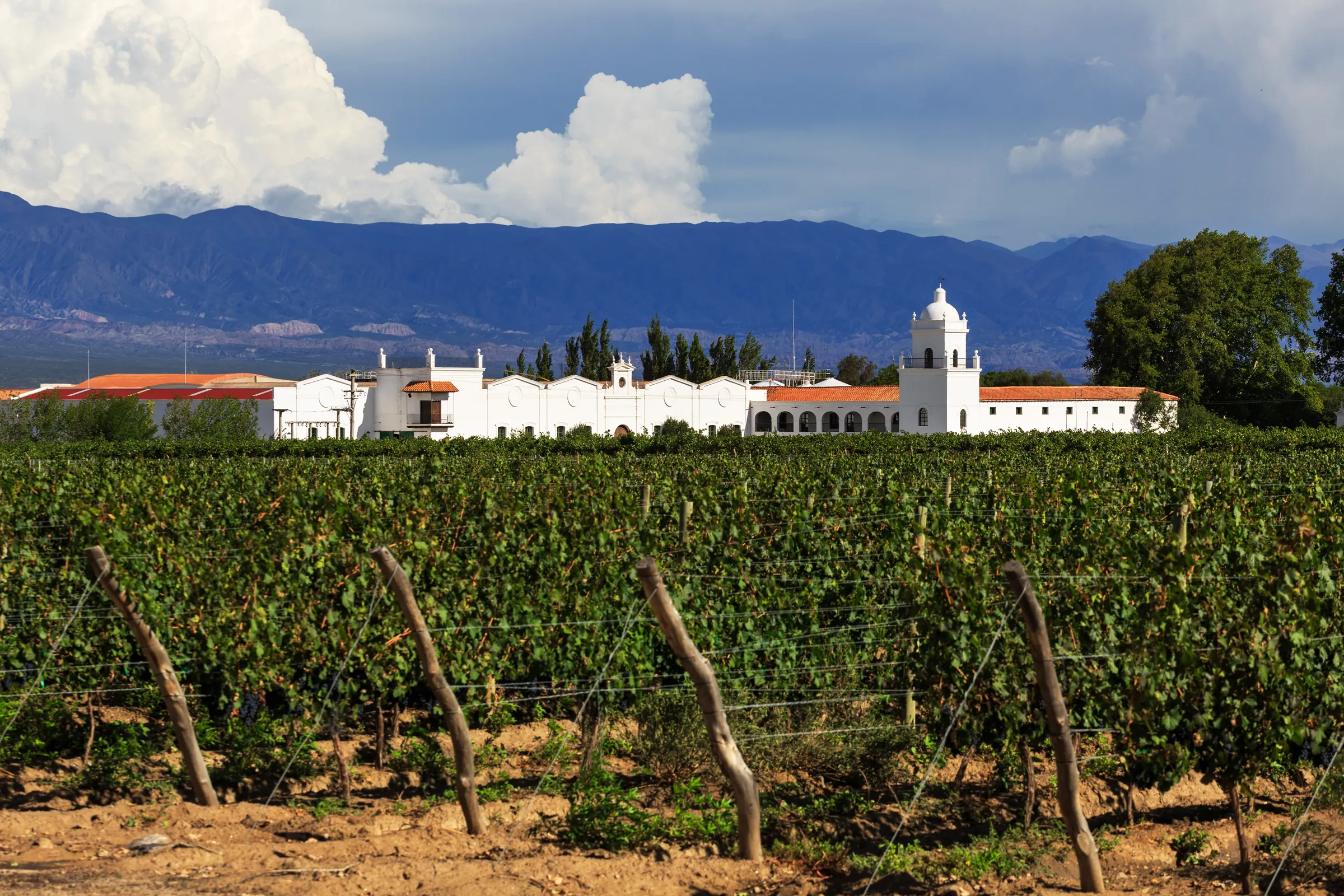
Mendoza Wine Country combines high-altitude vineyards, long countryside lunches, contemporary architecture, and the eastern face of the Andes. The region is not a single compact valley. Luján de Cuyo and Maipú contain many historic estates close to Mendoza city, Chacras de Coria has small hotels and restaurants, and the Uco Valley lies farther south beneath the Cordón del Plata. A well-planned stay uses location, elevation, architecture, agriculture, and food to keep each day distinct.
At a glance
| Best for | Vineyard landscapes, food, architecture, Andean scenery, wellness, and agricultural heritage |
|---|---|
| Don't miss | Luján de Cuyo, the Uco Valley, vineyard architecture, an asado, and an Andes excursion |
| Recommended stay | 4 to 5 nights |
| Best area to stay | Luján de Cuyo, Chacras de Coria, or the Uco Valley |
| Pairs well with | Buenos Aires, Northwest Argentina, Santiago & Central Chile, and Patagonia |
| Closest airport | Governor Francisco Gabrielli International Airport (MDZ) |
| Best time to visit | September through May |
| Getting around | Private transfers and guided regional excursions |
| Budget | $$$ to $$$$ |
Why stay in Mendoza Wine Country?
Mendoza is Argentina's leading wine destination, but the region's appeal goes beyond Malbec. Elevation, dry climate, intense sunlight, alluvial soils, and irrigation from Andean snowmelt produce distinct conditions across Maipú, Luján de Cuyo, and the Uco Valley. Private visits can compare long-established family estates with small projects and striking contemporary estates.
Luján de Cuyo is the traditional heart of Mendoza wine country. Historic vineyards, old-vine Malbec, and established producers sit within reach of Chacras de Coria and Mendoza city. Maipú has a warmer climate and many of the province's older agricultural estates. The Uco Valley is higher and cooler, with broad mountain views, newer architecture, and a strong concentration of countryside restaurants.
Food has become as important as the vineyard landscape. Many estates serve multi-course lunches based on produce from kitchen gardens, open-fire cooking, and regional ingredients. These meals can last several hours, so one or two substantial regional visits often create a better day than a crowded checklist.
The Andes add a second dimension. Travelers can spend a day following the mountain road toward Aconcagua, ride through vineyards or foothills, join a private cooking class, or use the hotel's spa between estate days. This makes Mendoza a comfortable choice for couples and mixed-interest groups, including travelers more interested in food, design, wellness, or mountains than wine.
Our take: split the stay between Luján de Cuyo or Chacras de Coria and the Uco Valley when time permits. The two areas differ enough in landscape and hotel style to justify changing bases, and the split reduces long daily transfers.
Is Mendoza Wine Country a good fit?
- Want guided visits focused on agriculture, architecture, and regional history.
- Enjoy long lunches and ingredient-driven cooking.
- Prefer vineyard hotels with mountain views.
- Are interested in architecture, agriculture, irrigation, or regional food.
- Want active options such as riding, cycling, or mountain excursions.
- Would like several restful days between city and wilderness travel.
Chile's central valleys are closer to the Pacific and often feel more compact. Mendoza has a drier, more expansive landscape, stronger high-altitude identity, and greater distances between its major subregions. It works best when the itinerary is paced around one or two substantial regional experiences per day rather than a long checklist.
Best things to do
Explore Luján de Cuyo
Visit historic estates, irrigation channels, vineyard landscapes, and contemporary buildings in one of Mendoza's oldest agricultural districts. Private guiding can focus on architecture, family history, sustainability, and the relationship between the Andes and the cultivated oasis.
Spend a day in the Uco Valley
The Uco Valley combines high-elevation vineyards with broad views of the Andes. Pair one in-depth estate visit with a long regional lunch and time to understand how altitude, water, and soil influence agriculture.
Book a countryside lunch
Many of Mendoza's strongest meals are served on rural estates rather than in the city. Menus may feature open-fire cooking, garden produce, regional beef, goat, trout, olive oil, and ingredients grown on the property.
Learn how Mendoza's cultivated oasis works
A guided agricultural visit explains how snowmelt, canals, elevation, and soil allow vineyards and orchards to grow in an otherwise dry region. The engineering of Mendoza's irrigation system is as important to the landscape as the crops themselves.
Visit during harvest
Late summer and early autumn bring grape picking, orchard work, and active agricultural estates. Harvest timing varies by altitude and crop, but February through April usually brings the most visible seasonal activity.
Explore the Andes
A guided day toward the high Andes introduces mountain valleys, reservoirs, and viewpoints along the route to Aconcagua Provincial Park. Conditions and altitude determine how far the excursion should go.
Ride through vineyards or foothills
Private horseback rides range from gentle vineyard routes to longer foothill outings. The best programs combine scenery with gaucho traditions and finish with a picnic or open-fire meal.
Take an Argentine cooking class
Learn the foundations of empanadas, chimichurri, seasonal salads, and asado techniques. Small private classes work well for couples, families, and groups with different levels of wine interest.


Where to stay
Stay in Luján de Cuyo or Chacras de Coria for historic estates, small restaurants, and shorter transfers from Mendoza city and the airport. This area suits a first or final night and for travelers who want access to both Maipú and Luján de Cuyo.
Stay in the Uco Valley for larger mountain views, contemporary estates, and a more rural experience. The valley lies about 75 to 100 minutes from Mendoza city, depending on the hotel, so it should be treated as a separate base rather than a daily excursion when the schedule includes several Uco Valley properties.
Stay in Mendoza city only when urban restaurants, parks, and nightlife are a priority. The city is pleasant, but most Osaviva travelers come for the vineyards and prefer to sleep among them.
For a four- or five-night trip, we often divide the stay between Luján de Cuyo and the Uco Valley. Three nights can work from one base, but travel times should guide the estate selection.
Our favorite hotels
Awasi Mendoza
Formerly Cavas Wine Lodge, Awasi Mendoza has 17 rooms, suites, and villas across a 55-acre vineyard in Agrelo. The property has private guiding, secluded accommodations, an established spa, and access to the wider Luján de Cuyo countryside.
The Vines Resort & Spa
Vineyards and the Andes surround spacious villas at The Vines in Mendoza’s Uco Valley. Guests can explore nearby wineries, create small-batch blends, or spend the day within the resort’s broad rural estate. The property has 33 villas.
Susana Balbo Winemaker's House & Spa Suites
This seven-suite property in Chacras de Coria was created by pioneering Argentine winemaker Susana Balbo and her family. Each private suite incorporates substantial spa facilities, and the small scale works especially well for travelers who prioritize food, estate access, and highly personal service.
Casa de Uco Vineyards & Wine Resort
Contemporary architecture faces the Andes across Casa de Uco’s vineyards and reflective lagoons. Riding, cycling, wine experiences, and large residential villas make the property well suited to both couples and small groups. The property has 21 rooms, suites, villas, and private houses. The resort sits within a 320-hectare wine estate.
Entre Cielos Wine & Wellness Hotel
Set within a 20-acre estate in Vistalba, Entre Cielos has 24 rooms and suites and Latin America's first traditional hamam. Choose it when spa time and Luján de Cuyo access matter as much as the regional schedule.
Best time to visit
September through May covers spring growth, summer vineyard activity, harvest, and autumn color. February through April is harvest season, bringing active estates and warm days, although exact picking dates vary by grape and elevation.
October, November, March, and April are particularly comfortable for combining estate visits with outdoor activities. December through February can be hot in the lower valleys. Winter is quieter and often clear, but vines are dormant, evenings are cold, and some experiences operate on reduced schedules.
Pair it with
- Buenos Aires for architecture, restaurants, museums, and tango.
- Northwest Argentina for high-altitude agriculture, salt flats, and desert valleys.
- Santiago & Central Chile for a two-country itinerary centered on vineyard architecture, food, and mountain scenery.
- Patagonia for glaciers, trekking, and remote lodges.
Getting there
Governor Francisco Gabrielli International Airport has regular connections with Buenos Aires and selected regional cities. Private transfers are essential because estates and hotels are spread across several valleys, and estate appointments run on fixed schedules.
Approximate travel times:
- Mendoza Airport to Mendoza city: 20 to 30 minutes
- Mendoza Airport to Chacras de Coria: 35 to 50 minutes
- Mendoza Airport to central Luján de Cuyo: 40 to 60 minutes
- Mendoza Airport to the Uco Valley: 1.5 to 2 hours
- Chacras de Coria to the Uco Valley: 1 to 1.5 hours
- Luján de Cuyo to Maipú: 30 to 50 minutes
We group regional visits by subregion and confirm lunches and estate appointments in advance. The distances look manageable on a map, but long meals, mountain roads, and fixed reservation times make careful routing important.

Frequently asked questions
How many nights should I stay?
Plan four to five nights for a relaxed trip. Three nights cover two full estate days from one base. Four or five allow time for both Luján de Cuyo and the Uco Valley, an Andes excursion, and a slower afternoon at the hotel.
Should I stay in Luján de Cuyo or the Uco Valley?
Choose Luján de Cuyo for historic estates, shorter airport transfers, and access to Chacras de Coria. Choose the Uco Valley for higher vineyards, contemporary estates, and broader mountain views. A split stay is ideal when you have at least four nights.
How should I pace each day?
One or two substantial regional experiences are usually enough, especially when one includes a long lunch. A crowded schedule leaves little time for architecture, gardens, mountain views, or the meal itself.
Is Mendoza interesting beyond wine?
Yes. The region is equally rewarding for food, agriculture, irrigation history, architecture, mountains, riding, gardens, and spa time. The itinerary can emphasize those interests from the start.
When is harvest season?
Harvest generally runs from February into April, with earlier picking in warmer areas and later activity at higher elevations. The exact timing changes each year and depends on grape variety and weather.
Is Mendoza suitable for families?
Yes, with the right hotel and activity mix. Vineyard picnics, cooking classes, riding, cycling, pools, and mountain excursions create variety between estate visits. Some estate activities have age restrictions or limited children's programming, so appointments need to be selected carefully.
Can the trip focus on food and nature rather than wine?
Yes. Mendoza has excellent food, olive oil, architecture, gardens, riding, hiking, mountain scenery, and wellness experiences. A trip can be built entirely around culinary, agricultural, outdoor, and design-focused activities.
Can Mendoza be combined with Chile?
Yes. Flights often create the simplest connection, and an overland crossing can be scenic when border and mountain conditions cooperate. The road may close during severe winter weather, so the itinerary needs flexibility and current operational checks.


