


The Galápagos archipelago lies approximately 600 miles from mainland Ecuador, where the convergence of ocean currents and the islands' isolation produced an exceptional concentration of endemic wildlife. Giant tortoises, marine iguanas, flightless cormorants, Galápagos penguins, sea lions, Darwin's finches, and several booby species can often be observed at close range, but every visit is controlled through designated sites, park rules, and authorized naturalist guides. No single route visits the entire archipelago, so the specific islands and landing sites matter more than a generic promise to see the Galápagos.
At a glance
| Best for | Endemic wildlife, snorkeling, natural history, geology, photography, small-ship expeditions, and active families |
|---|---|
| Don't miss | Giant tortoises, marine iguanas, sea lions, a volcanic landscape, guided snorkeling, and at least one remote island |
| Recommended stay | 7 to 10 nights, excluding mainland arrival nights |
| Best area to stay | A licensed expedition vessel for range, or Santa Cruz, San Cristóbal, and Isabela for a land-based trip |
| Pairs well with | Quito, Otavalo & Imbabura, the Cloud Forests, and the Ecuadorian Amazon |
| Primary airports | Seymour Airport on Baltra (GPS) and San Cristóbal Airport (SCY) |
| Best time to visit | Year-round, with a warmer season from December through May and a cooler season from June through November |
| Getting around | Expedition vessels, inter-island speedboats, small aircraft, private road transfers, and guided walks |
| Budget | $$$$ |
Why visit the Galápagos Islands?
The islands are a living study in adaptation. Species separated by relatively short stretches of ocean developed different forms and behaviors, while the age of the islands changes from the older eroded southeast to the younger volcanic west. Española has endemic mockingbirds and breeding waved albatrosses, Fernandina supports vast marine-iguana colonies on young lava, and Genovesa concentrates seabirds within a collapsed volcanic caldera.
Wildlife behavior is as important as the species list. Blue-footed boobies display on open ground, frigatebirds inflate red throat pouches, marine iguanas feed underwater, sea lions investigate snorkelers, and giant tortoises move through humid highlands. Visitors must remain on marked routes and keep the required distance even when animals approach.
A small-ship cruise reaches remote islands and allows guests to wake near a new visitor site each day. Land-based itineraries provide larger rooms, independent evenings, and more time in inhabited communities, but daily excursions cannot reproduce every cruise route. A combined trip can work well when planned around specific wildlife priorities rather than simply adding hotel nights before or after a cruise.
Seasons change the experience without creating a single best month. Warmer water and calmer seas often occur from December through May. From June through November, cooler nutrient-rich currents support intense marine activity, but water temperatures drop and seas can be rougher.
Our take: allow at least seven nights in the archipelago and compare exact itineraries before comparing cabin finishes. A well-routed smaller vessel or a carefully constructed three-island land program provides more value than a shorter trip with a more elaborate room.
Are the Galápagos Islands a good fit?
The Galápagos are a strong choice if you:
- Enjoy wildlife observation, snorkeling, geology, and active days.
- Value expert naturalist guides and tightly managed protected areas.
- Can follow rules around wildlife and remain on marked trails.
- Are comfortable with wet landings, small boats, lava, and uneven paths.
- Want to choose a trip according to species and islands rather than resort facilities.
- Accept that weather, sea conditions, and wildlife can alter daily plans.
Travelers seeking a conventional beach holiday may find the structure restrictive and the water cooler than expected. The archipelago is best understood as a protected expedition destination with beaches, not a Caribbean-style resort region.
Best things to do
Snorkel with sea lions and marine life
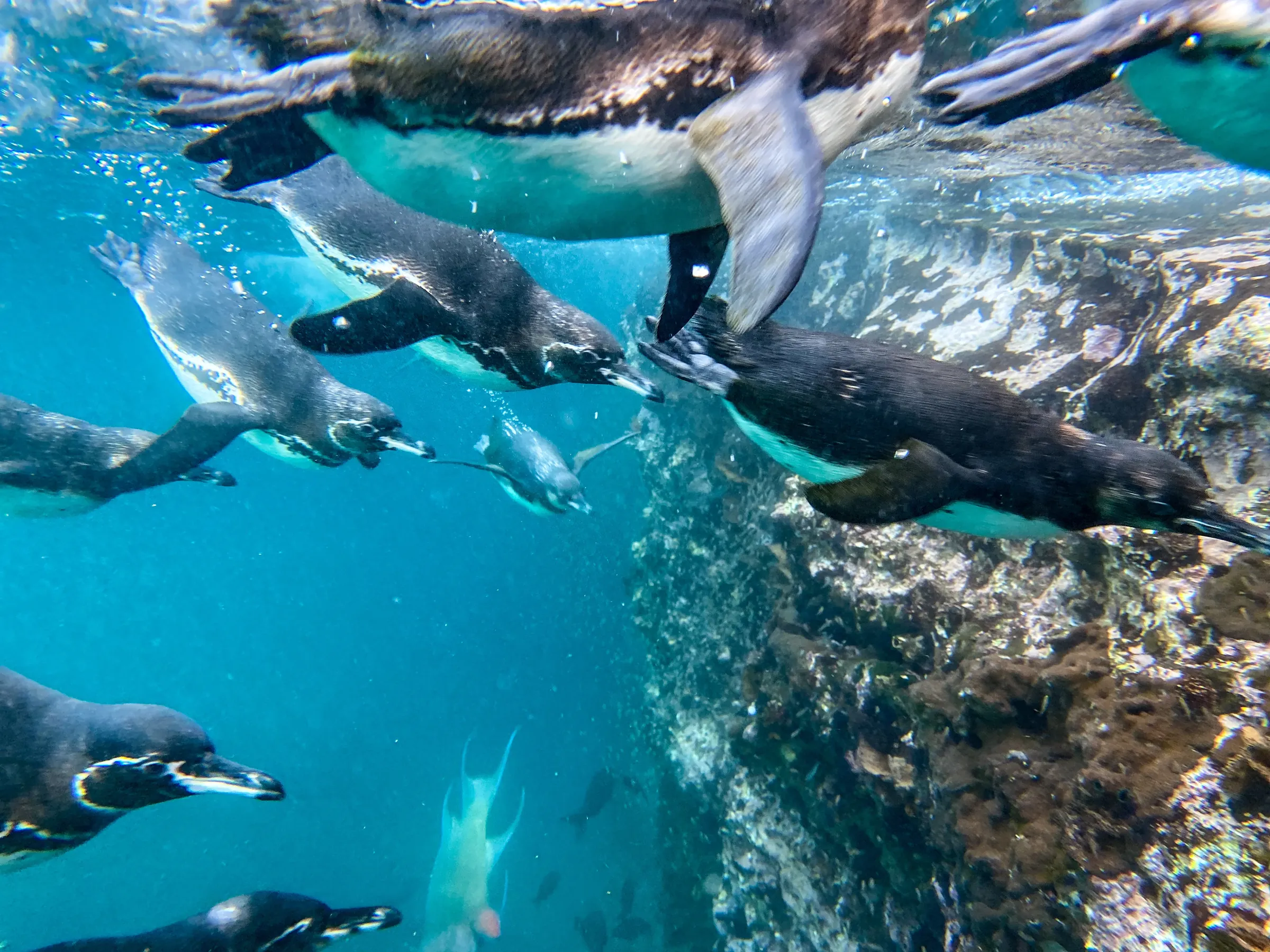
Guided snorkeling can reveal sea lions, sea turtles, rays, reef fish, marine iguanas, penguins, and occasionally sharks. Conditions vary greatly by site, current, season, and swimmer ability, so routes are selected each day by the guide and captain.
Walk among giant tortoises
Santa Cruz, Isabela, San Cristóbal, and several remote islands support distinct tortoise populations. Highland visits show the animals moving through natural or semi-natural habitat, while breeding centers explain restoration work and threats from introduced species.
Explore young volcanic terrain
Fernandina, western Isabela, Bartolomé, Santiago, and Chinese Hat reveal lava flows, craters, pioneer plants, and landscapes that change visibly with geological age. Naturalists explain how life recolonizes new rock.
Watch seabird colonies
Genovesa, Española, North Seymour, and other islands support nesting boobies, frigatebirds, tropicbirds, gulls, and albatrosses. Breeding activity varies by species and month, so route and timing should be matched to wildlife priorities.
Kayak or paddle along the coast
Protected bays and mangrove edges provide a low, quiet perspective on turtles, rays, sea lions, penguins, and shorebirds. Paddling is offered only at designated sites and depends on conditions.
Visit a tortoise or science center
Research and breeding centers on Santa Cruz, San Cristóbal, and Isabela explain invasive-species control, captive breeding, repatriation, and the continuing scientific work behind wildlife recovery.
Hike through island highlands
Humid uplands contrast sharply with the dry coast. Trails may pass scalesia forest, farms, lava tunnels, volcanic craters, and wild tortoise habitat within a relatively short drive from port.
Photograph wildlife responsibly
The animals' tolerance of people allows exceptional photography without approaching, feeding, touching, or blocking their path. Long lenses are useful, but patience and attention to park rules matter more than proximity.
What makes each major Galápagos island unique?
No itinerary includes every island below, and some have no regular visitor access. This guide explains the defining wildlife, geology, or history of the archipelago's principal islands and commonly referenced visitor sites.
Baltra
Baltra is one of the two principal air gateways and is connected to Santa Cruz by a short channel crossing. Its dry landscape, land iguanas, and military history are secondary to its logistical role, but arrival provides an immediate introduction to the archipelago's arid zone.
Santa Cruz
Santa Cruz has the archipelago's largest tourism center at Puerto Ayora, the Charles Darwin Research Station, lava tunnels, and lush highlands where giant tortoises roam private reserves. Its central position makes it the strongest land base and transport hub.
San Cristóbal
San Cristóbal contains Ecuador's provincial capital, Puerto Baquerizo Moreno, where sea lions occupy beaches and public spaces. Offshore Kicker Rock is one of the best-known snorkeling and diving sites, while the highlands include tortoise habitat, freshwater El Junco Lagoon, and an interpretation center.
Isabela
Isabela is the largest island and was formed by six shield volcanoes. Puerto Villamil provides access to wetlands, tortoise centers, Sierra Negra, lava tunnels, and marine sites, while the remote west supports penguins, flightless cormorants, marine iguanas, whales, and cold-water upwelling.
Floreana
Floreana is defined by human history as much as wildlife, including early settlers, unexplained disappearances, and the informal mail tradition at Post Office Bay. Punta Cormorant has a greenish beach, flamingo lagoon, and nearby snorkeling at Devil's Crown.
Española
Española is the principal breeding island for the waved albatross, generally present from roughly April through December. Punta Suárez also supports endemic mockingbirds and lava lizards, marine iguanas with distinctive breeding color, nesting seabirds, and a powerful blowhole, while Gardner Bay has a long white beach used by sea lions.
Genovesa
Genovesa is often called the bird island because large colonies of red-footed boobies, Nazca boobies, frigatebirds, gulls, and storm petrels occupy its caldera. Darwin Bay and Prince Philip's Steps provide two contrasting walks within one remote northern island.
Santiago
Santiago combines the young lava fields of Sullivan Bay with the eroded coastline at Puerto Egas, where visitors may see marine iguanas, shorebirds, sea lions, and Galápagos fur seals. The contrast makes geological change especially clear.
Fernandina
Fernandina is the youngest and one of the least altered large islands. Punta Espinoza is known for dense marine-iguana colonies, flightless cormorants, lava cacti, and recent volcanic surfaces beneath La Cumbre volcano.
Bartolomé
Bartolomé is recognized by Pinnacle Rock and a staircase to one of the archipelago's most photographed volcanic panoramas. Snorkeling near the beaches may include penguins, turtles, rays, and reef fish.
North Seymour
North Seymour has an open, relatively flat trail through colonies of blue-footed boobies and magnificent frigatebirds. Land iguanas and sea lions are also common, making the island especially strong for visible courtship and nesting behavior.
South Plaza
South Plaza is a small island with a dense population of land iguanas, sea-lion colonies, nesting red-billed tropicbirds, and cliffs above deep water. Seasonal vegetation can turn the ground vivid red and green around tall prickly pear cacti.
Santa Fe
Santa Fe has a sheltered turquoise bay, sea lions, large prickly pear cacti, and an endemic land iguana found nowhere else. The short terrestrial visit is often combined with snorkeling or kayaking along the rocky coast.
Rábida
Rábida's iron-rich volcanic material gives its beach and surrounding cliffs a deep red color. A small lagoon may attract flamingos, while pelicans nest nearby and the bay provides calm snorkeling when conditions allow.
Pinzón
Pinzón is important for the recovery of its endemic giant tortoise after invasive rats were removed. Regular land access is limited, but nearby marine sites can feature clear water, sea lions, rays, turtles, and reef fish.
Chinese Hat
Chinese Hat, or Sombrero Chino, is a small volcanic cone beside Santiago with striking lava formations, pioneer plants, marine iguanas, and a sheltered channel used for snorkeling. Its compact scale makes volcanic structure unusually easy to read.
Mosquera Islet
Mosquera is a low sand-and-lava islet between Baltra and North Seymour. It is known for a large sea-lion colony, shorebirds, and an open beach walk with little vegetation.
Darwin and Wolf
These remote northern islands have no standard land visits and are reached mainly by specialist liveaboard dive vessels. Strong currents and deep water attract schooling hammerheads, other sharks, rays, and seasonally whale sharks, making the sites appropriate for experienced divers rather than casual snorkelers.
Daphne Major and Daphne Minor
The steep volcanic Daphne islands are associated with long-running research on Darwin's finches. Landings are highly restricted, and most travelers see them only from a vessel or aircraft.
Pinta
Pinta is linked to Lonesome George, the last known individual of the island's original giant-tortoise species. Conservation work now focuses on restoring ecological processes, and the island is not part of most visitor routes.
Marchena
Marchena is a remote, sparsely visited volcanic island north of Santiago. It appears on only a limited number of expedition or diving routes and is valued for lava landscapes, marine life, and the absence of permanent settlement.

Where to stay
Choose an expedition vessel if visiting remote islands and maximizing wildlife variety are the priorities. Smaller ships carry fewer guests ashore at once, while larger vessels may have more cabin categories, medical facilities, and public space. The exact route and guide ratio matter more than vessel age alone.
Stay on Santa Cruz for the widest range of hotels, restaurants, highland tortoise experiences, and daily excursions. Puerto Ayora is the transport hub, but the most distinctive hotels sit outside town in the highlands or at the edge of the national park.
Stay on San Cristóbal for sea lions, Kicker Rock, easier airport logistics, and a more compact waterfront town. Stay on Isabela for beaches, wetlands, Sierra Negra, and a slower village atmosphere, accepting that transfers are longer and hotel choice is smaller.
A land-based itinerary normally uses two or three islands. A combined trip can add several hotel nights to a cruise, but the land program should contribute different sites rather than repeat the same highlands and research centers.
Our favorite hotels
Pikaia Lodge
Pikaia has 14 rooms on a private giant-tortoise reserve in the highlands of Santa Cruz. The property has contemporary architecture, broad crater views, a spa, and the lodge's own day-excursion vessel.
Galápagos Safari Camp
Tented suites occupy a private reserve in the forested highlands of Santa Cruz at Galápagos Safari Camp. A central lodge overlooks the volcanic landscape, while private guiding and yacht excursions create a more personalized way to explore the islands.
Finch Bay Galápagos Hotel
Finch Bay has 33 rooms beside a small beach near Puerto Ayora, reached by water taxi and a short walk. A pool, restaurant, kayaks, and hotel-operated day yacht suit travelers who want coastal access without staying in the center of town.
Montemar Eco Luxury Villas
Montemar consists of two private villas set within a reserve in the Santa Cruz highlands. Created by Galápagos naturalist guides, the property combines sustainable design with highly personalized exploration of the archipelago.
Iguana Crossing Boutique Hotel
Iguana Crossing has 14 rooms opposite the wetlands and beach at Puerto Villamil on Isabela. The property has rooftop terrace, pool, and position between town and national-park habitat.
Best time to visit
December through May is the warmer season, with warmer water, greener terrestrial landscapes, more frequent brief showers, and generally calmer seas. Snorkeling can be comfortable without a thick wetsuit, although rain and heat are more noticeable.
June through November is cooler and drier, with garúa, stronger winds, and nutrient-rich currents that support productive marine conditions. Penguins, seabirds, whales, and feeding activity can be especially rewarding, but water is colder and crossings may be rougher.
Pair it with
- Quito for colonial architecture, museums, and required mainland flight connections.
- Otavalo & Imbabura for markets, textiles, crater lakes, and highland haciendas.
- The Cloud Forests for hummingbirds, orchids, waterfalls, and a second endemic-rich ecosystem.
- The Ecuadorian Amazon for river wildlife and rainforest naturalist programs.
- The Avenue of the Volcanoes for Cotopaxi, Chimborazo, and Andean landscapes.
Getting there
Flights depart from Quito and Guayaquil for Baltra or San Cristóbal, often with a stop in Guayaquil. Travelers complete archipelago transit controls before departure from the mainland and national-park entry procedures on arrival. Requirements and fees can change and should be confirmed before travel.
Approximate travel times:
- Guayaquil to Baltra or San Cristóbal: 1 hour 45 minutes to 2 hours by air
- Quito to Baltra or San Cristóbal: 3.5 to 4.5 hours including the Guayaquil stop
- Baltra Airport to Puerto Ayora: 1.5 to 2 hours by bus, channel ferry, and road transfer
- San Cristóbal Airport to Puerto Baquerizo Moreno: 5 to 15 minutes
- Puerto Ayora to Puerto Villamil: 2 to 2.5 hours by public speedboat
- Puerto Ayora to Puerto Baquerizo Moreno: 2 to 2.5 hours by public speedboat
Inter-island speedboats can be enclosed, noisy, and rough. Small scheduled aircraft reduce travel time but have strict baggage limits. Cruise embarkation and disembarkation arrangements vary by route, so mainland flights should be booked only after the vessel schedule is confirmed.


Frequently asked questions
Should I choose a cruise or a land-based trip?
Choose a cruise for remote islands, greater daily range, and early access to visitor sites. Choose a land trip for larger rooms, independent evenings, and more time in inhabited communities. A carefully planned combination can provide both without duplicating sites.
How many nights should I spend in the Galápagos?
Seven nights in the archipelago is a strong minimum. Ten to fourteen nights allow a longer cruise, several land bases, or a combination that includes both remote and inhabited islands.
Which islands are best?
There is no single best island. Española and Genovesa are outstanding for seabirds, Fernandina and western Isabela for young geology and cold-water species, Santa Cruz for tortoises and land hotels, and San Cristóbal for sea lions and Kicker Rock. The right route depends on your priorities.
Will I get seasick?
It is possible, especially during open-water crossings and the cooler, windier season. Cabin location, vessel size, route, and individual sensitivity all matter. Discuss preventive options with a medical professional before travel rather than waiting until embarkation.
Can I touch or approach the animals?
No. Visitors must maintain the park's required distance, remain on marked routes, avoid feeding or touching wildlife, and follow the naturalist guide. Animals may approach on their own, but people must not block or pursue them.
Do I need to be a strong swimmer?
No, but swimming confidence expands the available experiences. Guides assess currents and conditions, and many vessels provide flotation devices and wetsuits. Travelers can skip individual water activities without missing every wildlife encounter.
Are the Galápagos suitable for families?
Yes, particularly for school-age children interested in animals and comfortable with boats, guided walks, and structured days. Vessel age policies, cabin layouts, swimming ability, and wet landings should be reviewed before booking.
What should I pack?
Bring sun protection, a brimmed hat, lightweight layers, a light rain jacket, supportive walking shoes, secure water sandals, swimwear, and a reusable water bottle. A wetsuit may be supplied, and baggage limits should be checked for small inter-island aircraft.


