

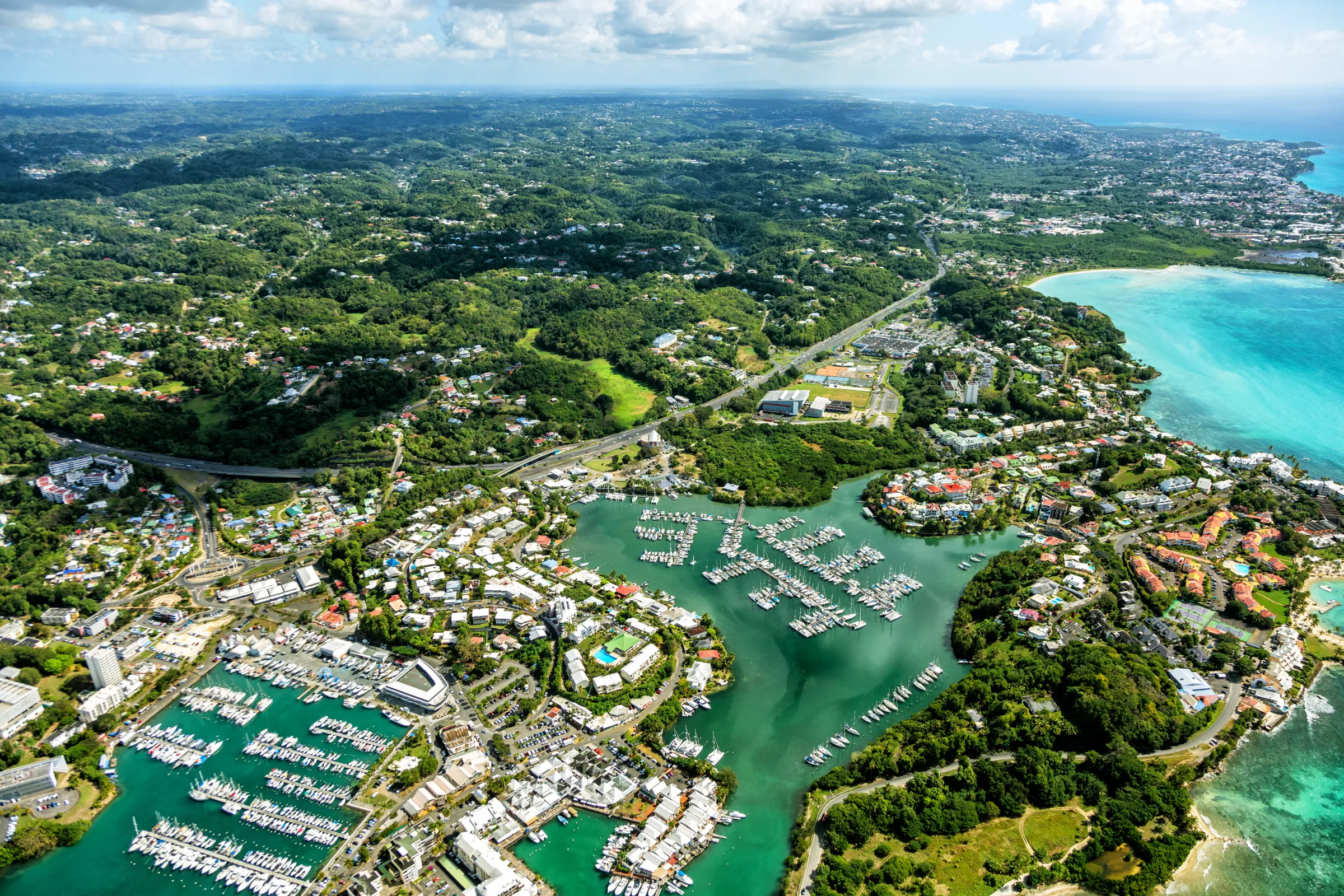
Guadeloupe's two principal islands form a butterfly-like shape around a narrow channel, but their landscapes are sharply different. Grande-Terre is flatter, drier, and edged by white-sand beaches, mangroves, and limestone cliffs. Basse-Terre is mountainous and volcanic, with rainforest, rivers, waterfalls, and La Soufrière rising above the national park. Offshore, Les Saintes, Marie-Galante, and La Désirade each have their own communities, architecture, food, and pace. French public services and culinary traditions coexist with Creole language, music, agriculture, and history throughout the archipelago.
At a glance
| Best for | Beaches, rainforest, hiking, diving, French Creole food, island-hopping, and independent exploration |
|---|---|
| Don't miss | Basse-Terre National Park, La Soufrière, the Cousteau Reserve, Les Saintes, and a Grande-Terre beach |
| Recommended stay | 7 to 10 nights |
| Best area to stay | Split between Grande-Terre and Basse-Terre, with an optional stay in Les Saintes or Marie-Galante |
| Pairs well with | Dominica, Antigua & Barbuda, or Martinique |
| Primary airport | Pointe-à-Pitre International Airport (PTP) |
| Best time to visit | December through May for generally drier weather, with regional rain possible year-round |
| Getting around | Private transfers, ferries, guided excursions, and chartered boats |
| Budget | $$ to $$$$ |
Why stay in Guadeloupe?
Grande-Terre contains the archipelago's largest concentration of beach hotels and restaurants. Sainte-Anne is known for a protected beachfront and market, Le Gosier is closer to Pointe-à-Pitre and nightlife, and Saint-François combines a marina, golf, beaches, and access toward Pointe des Châteaux. The eastern coastline becomes more exposed and dramatic near its limestone headlands.
Basse-Terre is the natural counterpoint. Guadeloupe National Park protects rainforest, rivers, volcanic slopes, and walking trails around La Soufrière. The Route de la Traversée crosses the interior through dense forest, while the Carbet Falls descend through the southern mountains. Weather is wetter and changes quickly, especially at elevation.
The west coast of Basse-Terre is also the center of the archipelago's best-known diving. The Cousteau Reserve around the Pigeon Islets contains coral, turtles, fish, and volcanic underwater terrain. Deshaies and nearby beaches provide a quieter coastal base than Le Gosier or Sainte-Anne.
Les Saintes is a small group south of Basse-Terre. Terre-de-Haut has a protected bay, Fort Napoléon, beaches, fishing boats, and a compact village linked through electric carts and scooters. Marie-Galante is larger and more agricultural, with cane fields, old windmills, beaches, and a circular island culture that rewards at least two nights.
Our take: use two mainland bases and add a smaller island when time allows. Attempting to cover Basse-Terre's trails, Grande-Terre's beaches, and offshore islands from one hotel creates unnecessary driving and ferry days.
Is Guadeloupe a good fit?
- Want beaches and rainforest within one archipelago.
- Enjoy French and Creole food, markets, and small coastal towns.
- Prefer independent hotels and regional variety to a single resort complex.
- Want hiking, diving, waterfalls, and island-hopping.
- Are comfortable with French signage and locally paced service.
- Have at least one week to divide between two or more areas.
Travelers seeking a seamless all-inclusive experience may find Guadeloupe more logistically involved. Its strength is the ability to build a varied trip across several islands and ecosystems.
Best things to do
Hike on La Soufrière
Trails climb through wet forest and exposed volcanic terrain toward the highest point in the Lesser Antilles. Cloud, wind, rain, and geothermal conditions change rapidly, so the route should be chosen with current local guidance.
Visit the Carbet Falls
Three major cascades descend through the southern Basse-Terre forest. The second fall has the most accessible established route, while other approaches are longer and can be affected by rain, erosion, or closures.
Dive or snorkel the Cousteau Reserve
Marine sites around the Pigeon Islets feature volcanic formations, turtles, reef fish, and coral. Qualified operators can match sites to beginner snorkelers, certified divers, and families with different water confidence.
Explore Les Saintes
Walk through Terre-de-Haut, visit Fort Napoléon, swim at a small beach, and look across one of the Caribbean's most distinctive bays. Staying overnight reveals a quieter island after day ferries leave.
Spend time on Grande-Terre's beaches
Choose between protected southern beaches, surf-exposed Atlantic sections, mangrove lagoons, and the cliffs near Pointe de la Grande Vigie or Pointe des Châteaux. Conditions differ enough that several coasts are worth comparing.
Visit Marie-Galante
The island's cane fields, windmill remains, coastal roads, small towns, and long beaches create a more agricultural experience than the main islands. A private guide can add context on labor, land use, and Creole traditions.
Explore markets and Creole kitchens
Markets display tropical produce, spices, seafood, prepared foods, and locally made products. Culinary experiences can explain how African, French, Indian, and Indigenous influences developed into Guadeloupean cooking.
Walk through the rainforest
Short national-park paths lead to rivers, forest pools, giant tree ferns, and waterfalls, while longer routes cross volcanic terrain. Rain protection and shoes with grip are useful even on apparently easy walks.


Where to stay
Stay in Sainte-Anne or Saint-François on Grande-Terre for white-sand beaches, restaurants, markets, and easier access to the eastern headlands. Le Gosier provides the shortest transfer to Pointe-à-Pitre and a broader nightlife scene.
Stay near Deshaies on northwest Basse-Terre for beaches, diving, botanical gardens, and the Route de la Traversée. Stay near Trois-Rivières for La Soufrière, Carbet Falls, and ferries toward Les Saintes.
Stay on Terre-de-Haut in Les Saintes for the bay, Fort Napoléon, small beaches, and evenings after day visitors depart. Stay on Marie-Galante for cane landscapes, quiet beaches, and a slower rural trip.
We recommend at least two hotels over a week. The mountain roads and narrow coastal routes make repeated day trips between Grande-Terre and southern Basse-Terre more tiring than the distances suggest.
Our favorite hotels
La Toubana Hôtel & Spa
La Toubana has 44 bungalows and suites plus three private villas on a hillside above Sainte-Anne. The property has a small beach, sea-facing terraces, a Sisley spa, and the island's most polished luxury service.
Le Jardin Malanga
Le Jardin Malanga has nine rooms and suites divided between a restored 1927 Creole house and three cottages in a tropical garden near Trois-Rivières. The property has views toward Les Saintes and is close to southern Basse-Terre's trails.
Hôtel Bois Joli
Hôtel Bois Joli has approximately 30 rooms and bungalows on the western edge of Terre-de-Haut in Les Saintes. Its waterfront position, pool, small beach, and distance from the busiest village streets suit travelers staying beyond a day trip.
La Créole Beach Hôtel & Spa
La Créole Beach has approximately 210 rooms in a tropical beachfront setting at Le Gosier. The property has pool, spa, family facilities, and is close to the airport.
Best time to visit
December through May is generally the driest period, with strong demand from French and North American travelers. Basse-Terre remains wetter than Grande-Terre because the mountains capture moisture throughout the year.
June through November is warmer and wetter, with tropical storms possible and the greatest seasonal risk generally occurring from August through October. Ferries, hiking routes, and marine excursions may be affected by wind or heavy rain.
Pair it with
- Dominica for more demanding hiking, whale watching, and a second volcanic island.
- Antigua & Barbuda for long beaches, sailing history, and a drier landscape.
- Martinique for another French Caribbean island with distinct food, towns, and terrain.
- A second Guadeloupe island for a deeper comparison of landscapes and communities.
Getting there
Pointe-à-Pitre International Airport is the main gateway and sits between Grande-Terre and Basse-Terre. Ferries depart from several ports for Les Saintes, Marie-Galante, La Désirade, Dominica, and Martinique according to current schedules.
Approximate travel times:
- Pointe-à-Pitre Airport to Le Gosier: 20 to 35 minutes
- Pointe-à-Pitre Airport to Sainte-Anne: 30 to 50 minutes
- Pointe-à-Pitre Airport to Deshaies: 1 to 1.5 hours
- Pointe-à-Pitre Airport to Trois-Rivières: 1 to 1.5 hours
- Trois-Rivières to Terre-de-Haut: 20 to 30 minutes by ferry
- Pointe-à-Pitre to Marie-Galante: approximately 1 hour by ferry
Traffic around Pointe-à-Pitre and weather-related ferry changes can extend journeys. We avoid tight flight connections after an offshore-island stay and confirm seasonal hotel closures before finalizing the route.


Frequently asked questions
Should I stay on Grande-Terre or Basse-Terre?
Choose Grande-Terre for white-sand beaches, restaurants, and easier resort facilities. Choose Basse-Terre for rainforest, hiking, waterfalls, diving, and smaller towns. A week-long first trip is better when divided between both.
How many nights should I stay?
Seven nights allow two mainland bases. Nine or ten nights provide enough time to add Les Saintes or Marie-Galante without turning every other day into a transfer.
Do I need to speak French?
English is spoken in some hotels and tourism businesses, but French is the principal language and signage is largely in French. Basic phrases and advance arrangements with bilingual guides make the trip smoother.
Is Guadeloupe suitable for families?
Yes. Protected beaches, waterfalls, markets, boats, and short forest walks work well for families. The right hotel depends on children's ages and the amount of movement between islands.
Can I visit Les Saintes as a day trip?
Yes, but an overnight provides time for Fort Napoléon, beaches, the village, and dinner after the main ferries leave. It also reduces pressure to fit the entire island into a few midday hours.
How difficult is the La Soufrière hike?
The main route is a substantial high-altitude walk in wet, windy conditions, with uneven volcanic terrain. Cloud can remove summit views, and access may change according to weather or geothermal monitoring.
Are restaurants and hotels open year-round?
Not always. Some smaller hotels, restaurants, and ferry services reduce operations during late summer and early autumn. Current opening dates should be checked before flights are confirmed.
What should I pack?
Bring lightweight clothing, a waterproof jacket, supportive trail shoes, water shoes, sun protection, and a small dry bag. A light warm layer is useful on La Soufrière and during windy ferry crossings.


