

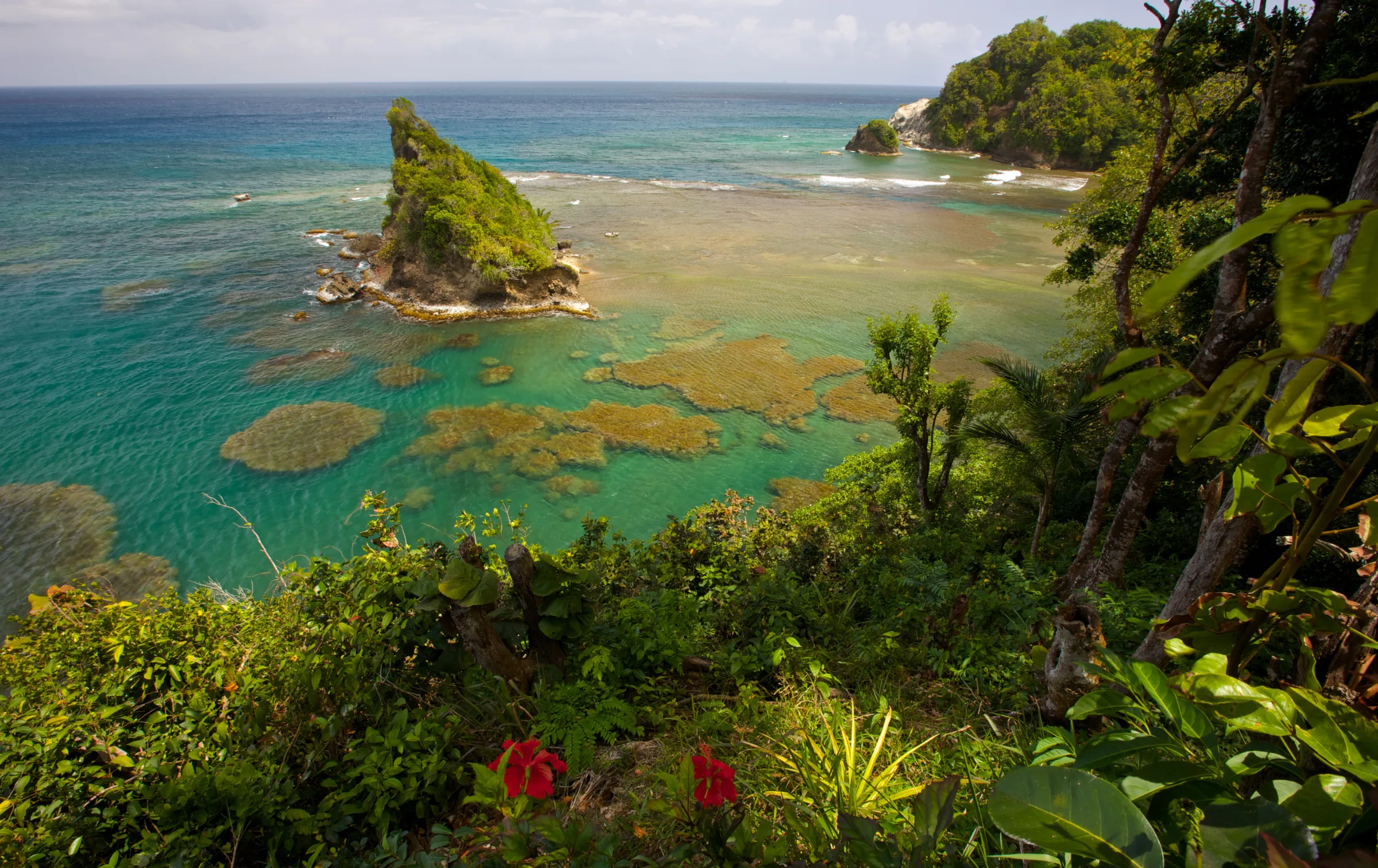
Dominica is a steep volcanic island covered by rainforest, rivers, hot springs, waterfalls, and deeply cut valleys. Roads follow the terrain rather than a simple coastal loop, and many of the best experiences require walking, boat travel, or specialist guides. Roseau and the southwest provide access to the Morne Trois Pitons landscape, the north contains Portsmouth, Cabrits, and the Indian River, and the east is home to the Kalinago Territory and a more exposed Atlantic coast.
At a glance
| Best for | Rainforest, hiking, waterfalls, canyoning, whale watching, diving, birding, and volcanic landscapes |
|---|---|
| Don't miss | Titou Gorge, Trafalgar Falls, a guided forest hike, sperm-whale watching, and the Indian River or Cabrits |
| Recommended stay | 5 to 8 nights |
| Best area to stay | The northwest for diving and Cabrits, or the southwest for hiking and volcanic sites |
| Pairs well with | Guadeloupe, Martinique, St. Lucia, or Antigua |
| Primary airport | Douglas-Charles Airport (DOM) |
| Best time to visit | February through May for generally drier conditions, with lush landscapes and rain possible year-round |
| Getting around | Private transfers, guided hikes, boats, and specialist activity operators |
| Budget | $$$ to $$$$ |
Why stay in Dominica?
Dominica's landscape is unusually intact for the Caribbean. Morne Trois Pitons National Park protects volcanic peaks, freshwater lakes, fumaroles, forest, and the route toward Boiling Lake. The island also contains numerous rivers and cascades, including Trafalgar Falls, Middleham Falls, Emerald Pool, and smaller sites known primarily to local guides.
The Boiling Lake hike is one of the region's most demanding day walks. The route crosses steep forest, ridges, mud, streams, and the geothermal Valley of Desolation before reaching the flooded fumarole. Trail conditions change after rain and volcanic activity, so the hike requires an authorized guide, strong fitness, and a full-day commitment.
Dominica is also one of the few places where resident sperm whales can be encountered throughout the year. Boat trips use trained crews and hydrophones to locate animals offshore, although sightings are never guaranteed. The same deep underwater terrain supports strong diving close to the coast.
Portsmouth and the northwest have a gentler marine focus. Cabrits National Park combines forest trails, Fort Shirley, and views across Prince Rupert Bay. The Indian River is explored by hand-rowed boat through mangroves and swamp forest, with guides interpreting plants, birds, and local history.
The Kalinago Territory on the east coast is home to the Caribbean's largest remaining Indigenous community. Responsible visits should be arranged with local guides and community-run initiatives, with attention to contemporary life, land, language, crafts, and governance rather than reducing the experience to a performance.
Our take: plan active mornings and flexible afternoons, and use two bases only when the stay is at least seven nights. Dominica is not a resort island with optional excursions. The landscape and guides are the reason to travel.
Is Dominica a good fit?
- Prefer hiking, rivers, wildlife, and rainforest to long resort beaches.
- Enjoy small hotels and conservation-led properties.
- Are comfortable with rain, steep roads, mud, and changing trail conditions.
- Want guided activities ranging from gentle to highly demanding.
- Are interested in whales, diving, birds, geology, and Indigenous culture.
- Value a quieter island with limited nightlife and fewer large resorts.
Travelers seeking broad white-sand beaches, highly polished shopping districts, or a conventional all-inclusive trip should choose another island. Dominica's luxury lies in access, guiding, and natural surroundings.
Best things to do
Hike to Boiling Lake
This strenuous full-day route crosses forest, steep ridges, riverbeds, and geothermal terrain. It should be attempted only with an experienced local guide, proper footwear, sufficient water, and current confirmation that the trail is open and safe.
Swim through Titou Gorge
A narrow gorge leads through cool water toward a hidden waterfall. Flotation equipment and local guidance are useful because current, water depth, and temperature vary after rain.
Visit Trafalgar Falls and Wotten Waven
The twin falls are reached by a short forest path, while the nearby village area contains geothermal pools and small wellness facilities. Combining the two creates a gentler alternative to a full-day hike.
Look for sperm whales
Specialist boats travel offshore with trained crews who use local knowledge and acoustic equipment. Trips may also encounter dolphins and seabirds, but wildlife behavior and sea conditions determine each outing.
Explore the Indian River
Hand-rowed boats move slowly through a shaded river corridor near Portsmouth. Guides point out mangrove roots, birds, fish, and plants while explaining how the river has been used by local communities.
Visit Cabrits and Fort Shirley
Restored military buildings occupy a forested peninsula between two former volcanic peaks. Trails connect viewpoints, ruins, and coastal habitats within a relatively compact national park.
Dive or snorkel at Champagne Reef
Geothermal bubbles rise through the water near the southern coast, adding an unusual feature to a reef with fish, corals, and volcanic topography. Water entry and surface conditions should be assessed on the day.
Spend time in the Kalinago Territory
Community-led visits can introduce cassava processing, basketry, medicinal plants, architecture, and current cultural initiatives. The experience should be arranged through local hosts and allow time for discussion.

Where to stay
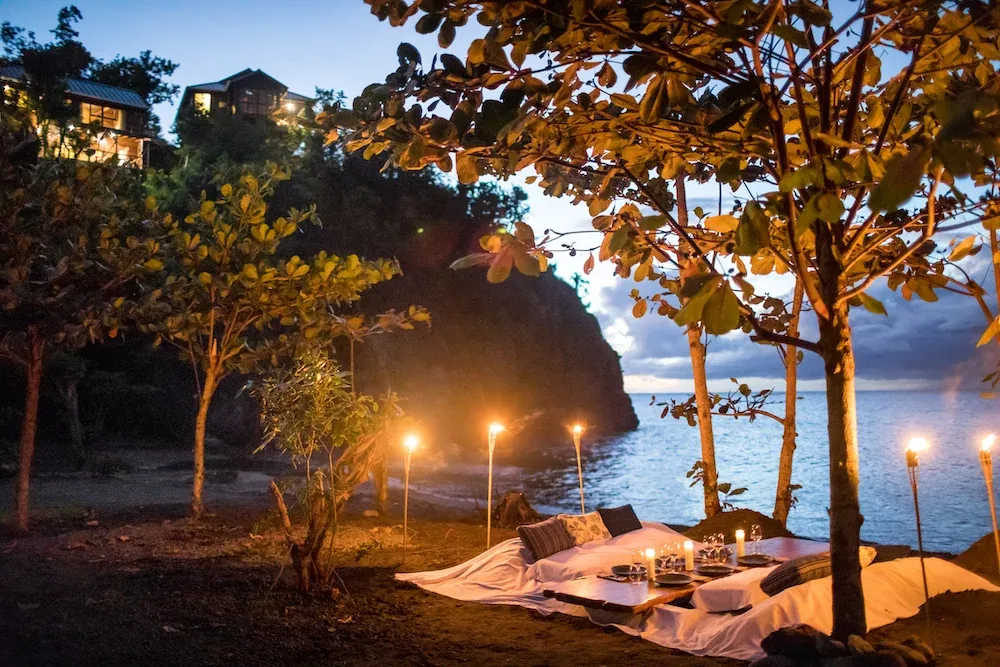
Stay near Portsmouth and Cabrits for diving, the Indian River, Fort Shirley, whale-watching departures, and the island's largest full-service resort. The northwest has a calmer Caribbean coast than much of the east.
Stay near Soufrière, Roseau, or the southwest for Titou Gorge, Trafalgar Falls, Boiling Lake, Champagne Reef, and geothermal sites. Properties range from small guesthouses to highly private villa resorts.
Stay in the southeast for seclusion, forest, and design-led eco-lodges. Road journeys to the north are long, so the area is best for travelers content to focus on the southern half of the island.
We recommend one base for five nights and two bases for a week or longer. The island is not large in distance, but mountain roads make repeated north-south excursions tiring.
Our favorite hotels
Secret Bay
Secret Bay has 27 private villas across more than 40 forested acres near Portsmouth. The property has private pools, kitchens, a funicular, and highly personalized service.
Jungle Bay Dominica
Jungle Bay has 89 villa suites across approximately 20 acres near Soufrière. The property has yoga, wellness programs, gardens, pools, and access to the southern hiking sites.
Coulibri Ridge
Coulibri Ridge has 14 suites on a 285-acre estate above the south coast. Solar energy, rainwater systems, large residences, and broad ocean views distinguish it as Dominica's most design-led sustainability project.
InterContinental Dominica Cabrits Resort & Spa
This 151-room resort sits beside Cabrits National Park near Portsmouth. The property has multiple pools, a full spa, family facilities, and immediate access to the northwest.
Best time to visit
February through May is generally the driest period, although showers remain common in the mountains and rainforest. These months usually provide the most reliable trail conditions for long hikes.
June through November is wetter, with tropical storms possible and the greatest seasonal risk generally occurring from August through October. Rivers, waterfalls, and vegetation can be especially dramatic, but heavy rain may close trails or alter canyon and river activities.
Pair it with
- Guadeloupe for French Caribbean culture, beaches, and ferry or air connections.
- Martinique for restaurants, towns, beaches, and a second volcanic island.
- St. Lucia for the Pitons, resort infrastructure, and a more honeymoon-focused stay.
- Antigua for long beaches and a drier landscape after Dominica's rainforest.
Getting there
Douglas-Charles Airport on the northeast coast handles regional and selected longer-distance services. Ferries link Roseau with neighboring French islands on scheduled routes. Transfer times are substantial because the airport and many hotels sit on opposite sides of mountainous terrain.
Approximate travel times:
- Douglas-Charles Airport to Portsmouth: 1 to 1.5 hours
- Douglas-Charles Airport to Roseau: 1.5 to 2 hours
- Douglas-Charles Airport to Soufrière: 2 to 2.5 hours
- Portsmouth to Roseau: 1 to 1.5 hours
- Roseau to Titou Gorge: 30 to 45 minutes
- Roseau to the Kalinago Territory: 1.5 to 2 hours
Mountain roads, rain, and local traffic can extend journeys. We leave generous buffers before flights and ferries and avoid placing a demanding hike immediately after a late arrival.


Frequently asked questions
Does Dominica have good beaches?
It has small volcanic beaches and attractive bays, but not the long white-sand resort beaches found in Antigua or Turks & Caicos. Travelers should choose Dominica for rainforest, rivers, hiking, diving, and wildlife.
How many nights should I stay?
Five nights provide three or four full activity days. Seven or eight nights allow both northern and southern bases, weather flexibility, and recovery time between demanding hikes.
How difficult is the Boiling Lake hike?
It is very strenuous and can take most of the day. Steep climbs, mud, river crossings, heat, rain, and geothermal terrain require strong fitness, proper equipment, and an experienced guide.
Will I see sperm whales?
Dominica supports resident sperm whales throughout the year, but no sighting is guaranteed. Multiple outings improve flexibility, and the best operators follow responsible approach distances and observation practices.
Is Dominica suitable for families?
Yes, especially for active families with older children. Waterfalls, the Indian River, snorkeling, wildlife, and shorter forest walks can be adapted, while canyoning and Boiling Lake require greater ability and maturity.
Do I need a guide?
Guides are essential for Boiling Lake and highly valuable for canyoning, wildlife, the Kalinago Territory, and less-marked trails. They also monitor recent rain, river levels, and local access conditions.
Should I split the stay between north and south?
Do so when the trip is seven nights or longer. For a shorter stay, choose the hotel according to the highest-priority activities and accept one or two longer transfer days.
What should I pack?
Bring quick-drying layers, a waterproof jacket, trail shoes with strong grip, water shoes, insect repellent, sun protection, and a small dry bag. Pack a second pair of shoes because the first may remain wet.


