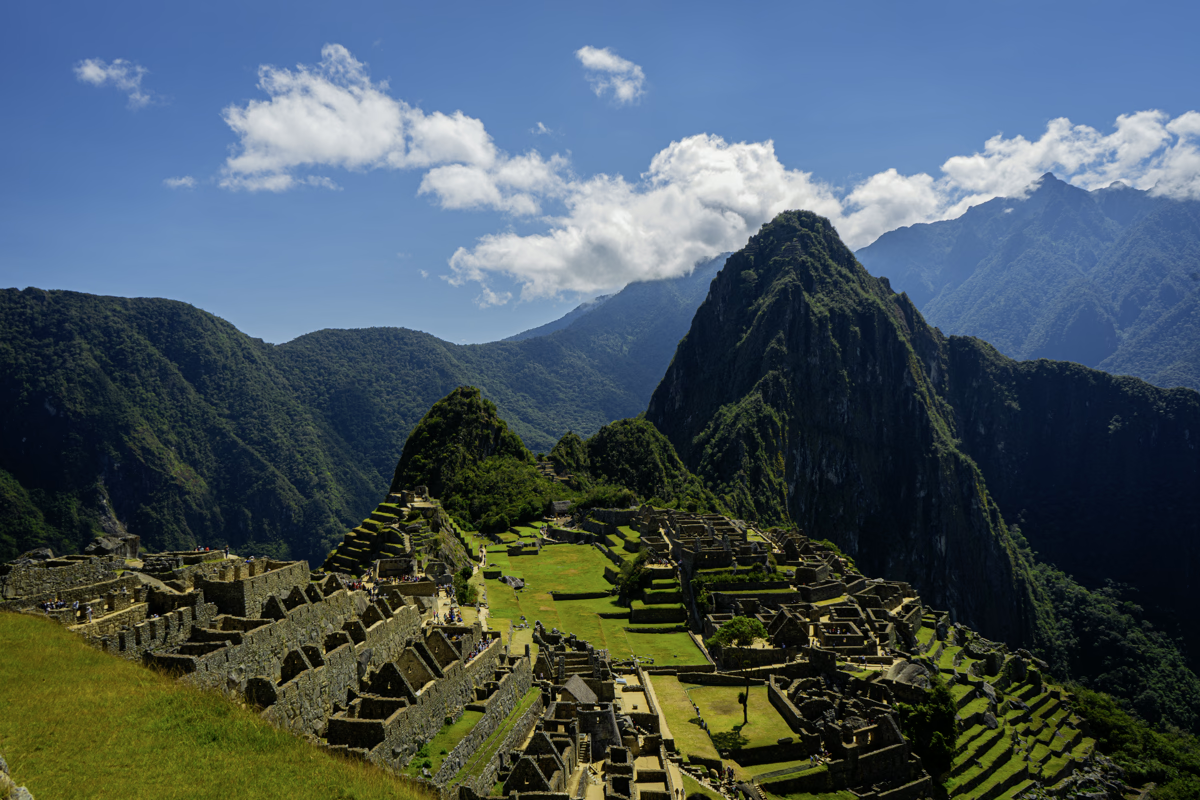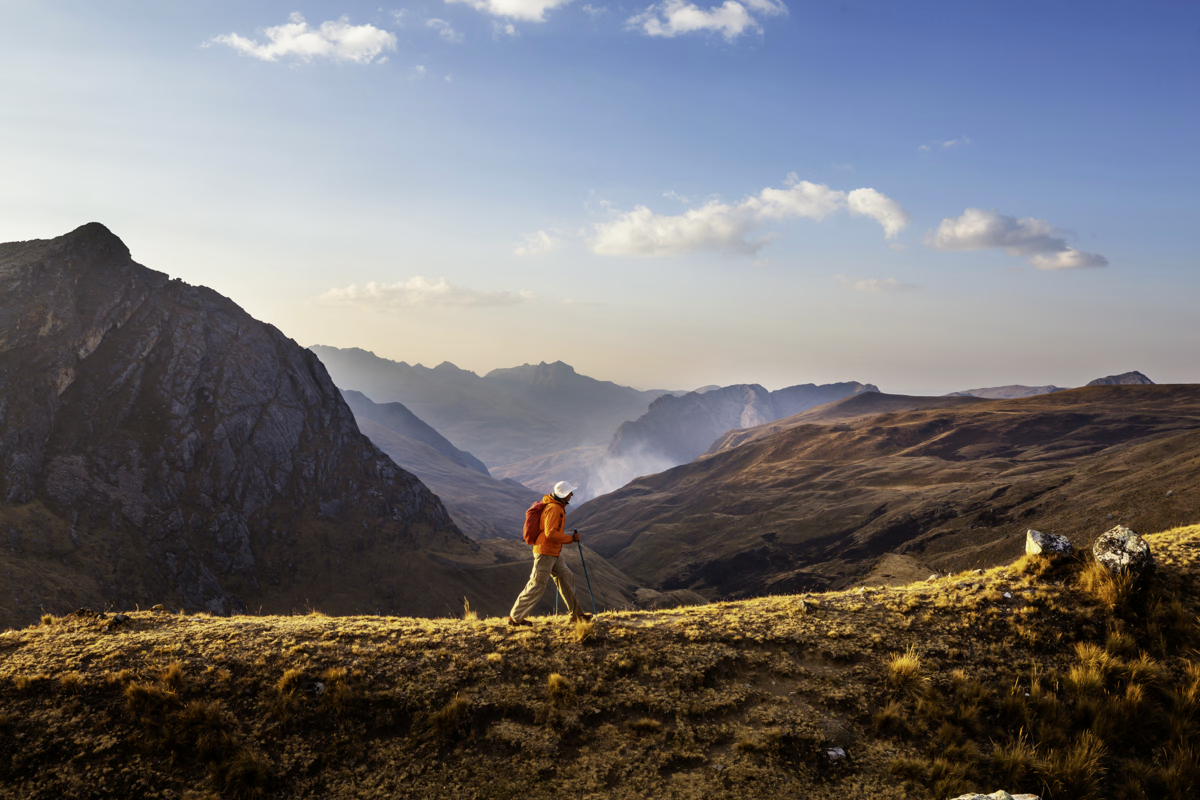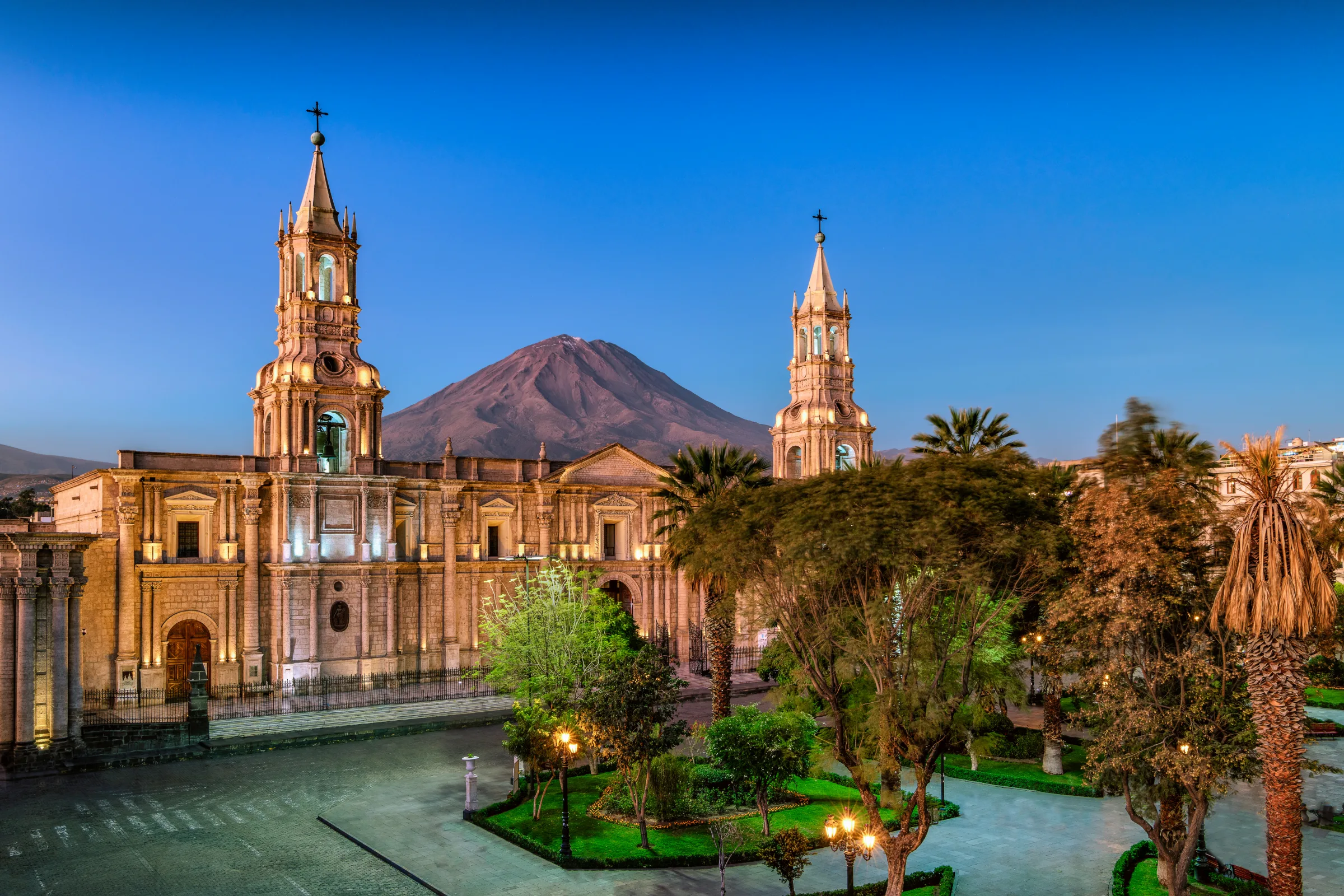
Arequipa & Colca Canyon bring together two complementary parts of southern Peru. Arequipa is built from pale volcanic sillar and framed by the peaks of Misti, Chachani, and Pichu Pichu. Several hours inland, the Colca Valley follows ancient agricultural terraces through high-altitude villages before the landscape narrows toward the canyon and the condor viewpoints near Cabanaconde. The route works particularly well between Lima, Lake Titicaca, and Cusco.
At a glance
| Best for | Colonial architecture, volcanic landscapes, condors, Andean villages, food, and canyon scenery |
|---|---|
| Don't miss | Santa Catalina Monastery, Arequipa's historic center, the Colca terraces, Yanque, and Cruz del Cóndor |
| Recommended stay | 4 to 6 nights |
| Best area to stay | Arequipa's historic center and two or three nights in the Colca Valley |
| Pairs well with | Lake Titicaca, Cusco, the Sacred Valley & Machu Picchu, and Lima |
| Closest airport | Rodríguez Ballón International Airport (AQP) |
| Best time to visit | April through November, with the clearest conditions from May through September |
| Getting around | Private transfers, guided city walks, and selected hikes |
| Budget | $$ to $$$$ |
Why stay in Arequipa & Colca Canyon?
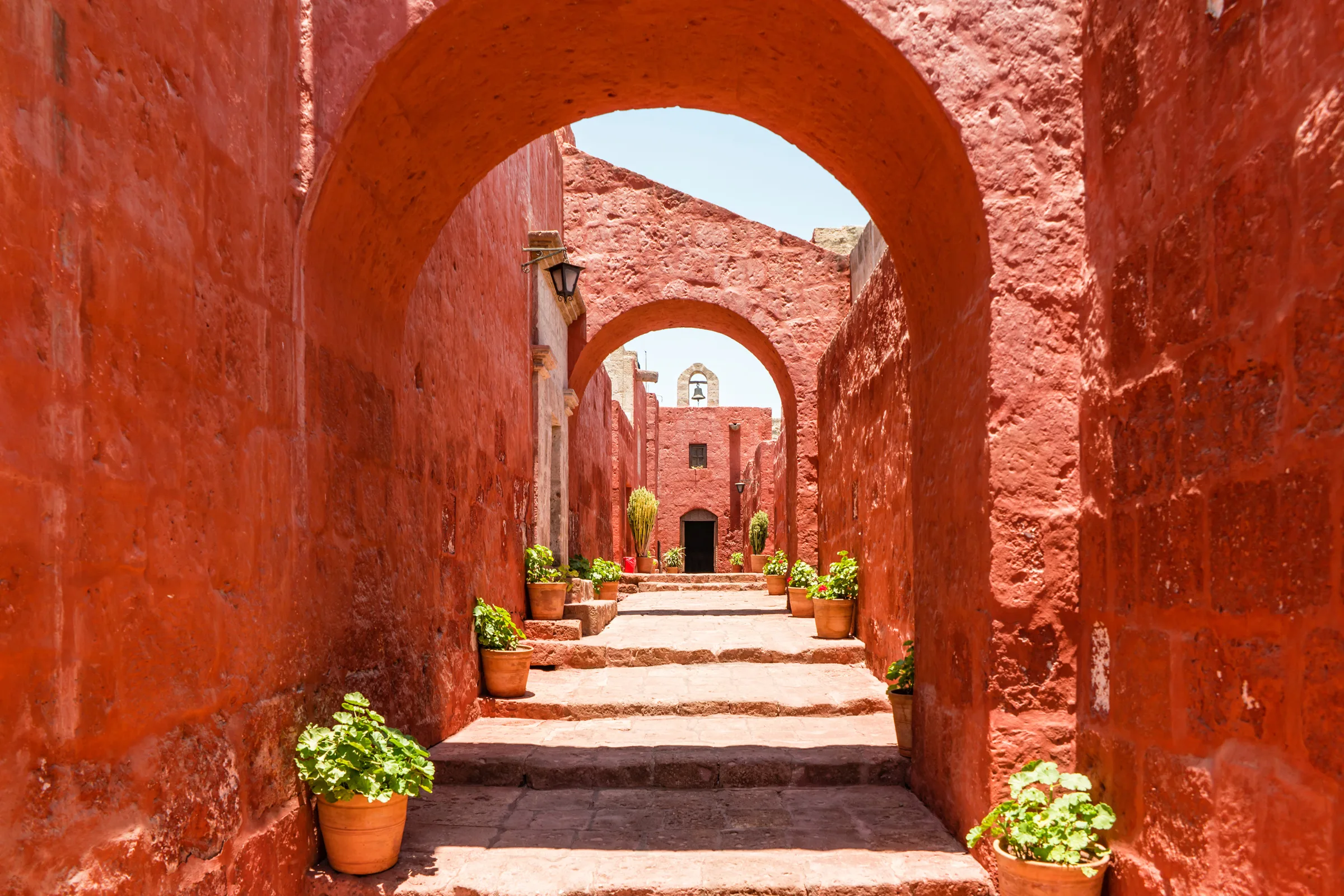
Arequipa's historic center is one of Peru's most coherent colonial cityscapes. Sillar, a pale volcanic stone, gives churches, arches, courtyards, and carved façades a distinctive appearance. The enormous Santa Catalina Monastery contains streets, cells, kitchens, cloisters, and chapels that function almost like a small city within the city.
Arequipa also has one of Peru's strongest regional food traditions. Picanterías serve dishes such as rocoto relleno, chupe de camarones, adobo, and ocopa, often in spacious courtyards with menus tied to specific days of the week. Markets and cooking experiences provide a useful introduction before the journey into Colca.
The drive to Colca crosses the Salinas y Aguada Blanca National Reserve, where vicuñas graze beneath volcanoes and the road rises above 15,000 feet before descending toward Chivay and Yanque. The high pass is one reason to avoid an immediate same-day return from the canyon. A slower stay allows time to rest and visit communities, hot springs, terraces, and viewpoints without spending most of the day in a vehicle.
Colca's agricultural landscape was developed over many centuries by pre-Inca cultures and continues to be cultivated. Villages preserve churches, festivals, textiles, and farming traditions distinct from those around Cusco. At Cruz del Cóndor, Andean condors use rising air currents along the canyon walls, although sightings depend on weather and wildlife movement.
Our take: spend two nights in Arequipa and at least two in Colca. The city deserves time beyond an arrival evening, and the canyon is far more rewarding when condor viewing is one part of a broader valley experience.
Is Arequipa & Colca Canyon a good fit?
- Enjoy architecture, regional food, and smaller historic cities.
- Want high-altitude scenery without centering the trip on Inca sites.
- Are interested in condors, vicuñas, and Andean landscapes.
- Prefer two or three nights in a rural lodge over a single long excursion.
- Want to connect southern Peru by road rather than returning to Lima.
- Appreciate hot springs, short hikes, and village visits.
Travelers highly sensitive to altitude should plan carefully because the route to Colca crosses a very high pass. Arequipa sits lower than Cusco and Puno, making it a useful place to begin acclimatizing before continuing deeper into the Andes.
Best things to do
Explore Santa Catalina Monastery
This vast complex of courtyards, streets, chapels, and former living quarters occupies an entire city block. A guide can explain how the monastery functioned socially and economically from the sixteenth century onward.
Walk through Arequipa's historic center
Visit the Plaza de Armas, cathedral, Iglesia de la Compañía, and sillar mansions with carved portals and internal courtyards. Rooftop viewpoints reveal how closely the city is framed by volcanoes.
Experience Arequipeño food
Lunch at a traditional picantería introduces the region through its own ingredients, cooking methods, and daily dishes. Market visits and private cooking sessions can provide more context than a single formal restaurant meal.
Cross the Salinas y Aguada Blanca National Reserve
The route into Colca passes volcanoes, wetlands, high plateaus, and herds of wild vicuñas. Stops should be brief at the highest viewpoints because the road climbs rapidly before descending into the valley.
Watch for condors at Cruz del Cóndor
Morning visits provide the best-known opportunity to see Andean condors circling above the canyon. Arriving with a private guide allows more flexibility than a rushed group stop and creates time for nearby viewpoints if conditions change.
Visit Yanque and the Colca villages
Yanque, Maca, Cabanaconde, and smaller settlements reveal the valley's churches, textiles, agriculture, and local festivals. Visits are most meaningful when they include resident guides, workshops, or farms rather than only a stop at the central plaza.
Walk among the terraces
Short and half-day routes cross pre-Inca agricultural terraces, river valleys, and rural paths. Longer canyon descents are demanding and require a separate plan, but many travelers can experience the landscape without a strenuous multi-day trek.
Relax in natural hot springs
Thermal water emerges at several points around the valley, and some lodges maintain private pools beside the river. An afternoon soak is especially useful after a high-altitude drive or morning walk.


Where to stay
Stay inside Arequipa's historic center for immediate access to Santa Catalina, the Plaza de Armas, churches, museums, restaurants, and restored sillar architecture. The best boutique hotels occupy former monasteries and colonial houses within a few blocks of the main square.
Stay in Yanque or the surrounding Colca Valley for quieter nights, terraces, village access, and shorter journeys to the major canyon viewpoints than a base in Arequipa. Chivay has more services but less privacy and architectural character than the rural properties outside town.
Stay near Cabanaconde if the priority is a demanding canyon trek. For most luxury itineraries, Yanque creates the better balance between comfort, village visits, condor viewing, and onward travel to Puno or Arequipa.
We recommend two separate bases. Attempting Colca as a day trip from Arequipa requires a very early departure, several hours at high elevation, and little time for the villages and terraces that make the region distinctive.
Our favorite hotels
CIRQA
CIRQA has 11 rooms in a former monastery dating to the sixteenth century, less than two blocks from Arequipa's Plaza de Armas. The property has restored sillar vaults, a small courtyard, rooftop views, and a strong restaurant.
Puqio
Eight adobe rooms and tented accommodations sit across a high-Andean landscape near the Colca Canyon. Puqio pairs close contact with local communities and agricultural traditions with guided exploration of one of Peru’s most dramatic valleys.
Las Casitas, A Belmond Hotel, Colca Canyon
Las Casitas contains 20 private casitas across a large estate near Yanque. Each has a terrace and heated plunge pool, and the property includes gardens, a spa, and resident animals.
Colca Lodge Spa & Hot Springs
Colca Lodge sits beside the river with its own thermal pools, simple adobe-influenced architecture, and direct access to valley trails. Its defining feature is the ability to move between excursions and natural hot springs without leaving the property.
Best time to visit
April through November is generally the driest period. May through September brings clear skies and cold nights, particularly in Colca. Daytime sun can still be intense at altitude, so layers and sun protection are required even in winter.
December through March brings more rain and greener terraces. Roads and trails can be affected during heavy weather, but the landscape is especially vivid. Condors live in the region year-round, although sightings are never guaranteed.
Pair it with
- Lake Titicaca by continuing across the Altiplano from Colca to Puno.
- Cusco, the Sacred Valley & Machu Picchu for a complete southern Peru route.
- Lima for international connections, museums, and coastal cuisine.
Getting there
Arequipa is reached by direct flights from Lima and selected domestic cities. The Colca Valley is accessed by road across a high pass in the Salinas y Aguada Blanca National Reserve. Many itineraries continue from Colca to Puno, avoiding a return journey to Arequipa.
Approximate travel times:
- Lima to Arequipa: 1 hour 30 minutes by air
- Arequipa Airport to the historic center: 30 to 45 minutes
- Arequipa to Yanque or Chivay: 3.5 to 4.5 hours
- Yanque to Cruz del Cóndor: 45 to 60 minutes
- Colca Valley to Puno: 6 to 7 hours
The drive into Colca climbs much higher than the hotels, so the day should include measured stops, water, and a lighter schedule on arrival. Private transfers allow the route to be adjusted around wildlife, weather, and each traveler's response to altitude.

Frequently asked questions
How many nights should I stay?
Plan four to six nights: two in Arequipa and two or three in Colca. Add a night if you want a longer hike, more time for food and architecture, or a slower onward journey to Lake Titicaca.
Can I visit Colca Canyon as a day trip?
It is possible, but we do not recommend it. The journey is long, the road crosses very high terrain, and day trips often focus almost entirely on one condor viewpoint. Two nights allow time for villages, terraces, short walks, and rest.
Will I definitely see condors?
No. Cruz del Cóndor is one of the region's most reliable viewing areas, but wildlife and weather remain unpredictable. Multiple mornings in the valley improve flexibility if wind, cloud, or animal movement is unfavorable.
Is Colca higher than Cusco?
Some points on the access road are considerably higher than Cusco, although the main valley hotels sit lower than the pass. This rapid climb is why Arequipa first and a moderate first afternoon in Colca are sensible.
Do I need to hike into the canyon?
No. Viewpoints, terraces, villages, hot springs, and condor watching can all be experienced without a major descent. Canyon treks are strenuous because of the elevation change and should be planned separately.
What is special about Arequipa's architecture?
Many historic buildings are constructed from sillar, a pale volcanic stone quarried near the city. Its carved portals, vaulted rooms, and bright courtyards give Arequipa a visual identity distinct from Cusco and Lima.
Is the region suitable for families?
Yes, with a careful pace. Santa Catalina, markets, vicuña sightings, hot springs, village visits, and shorter walks work well for families. Long drives and altitude require realistic daily schedules and regular breaks.
Can I continue directly from Colca to Lake Titicaca?
Yes. A private or scheduled transfer can continue across the Altiplano to Puno, making Colca a logical bridge between Arequipa and Lake Titicaca. The journey is long but avoids backtracking to Arequipa.