

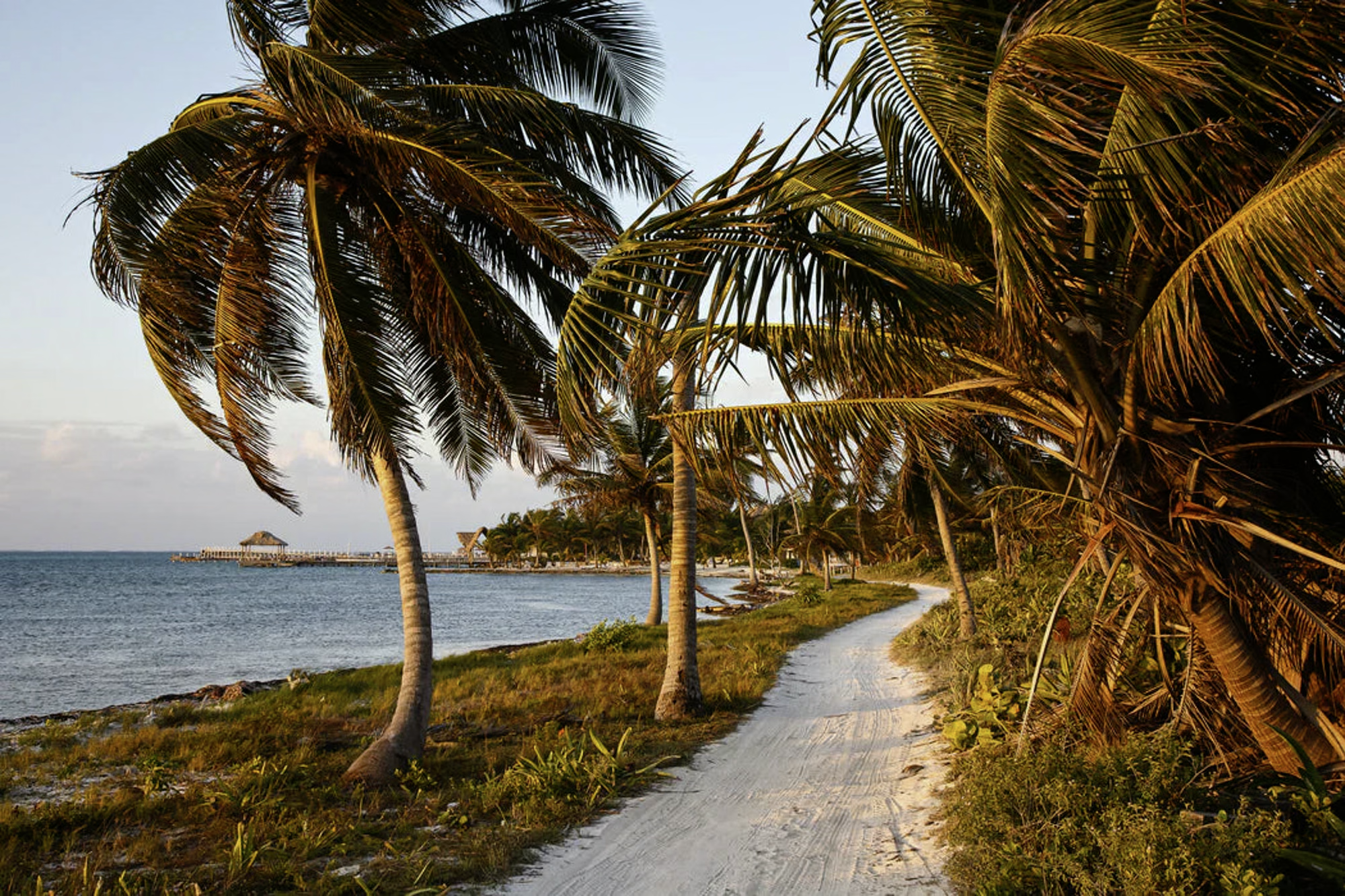
You've probably got a few tabs open right now: a jungle lodge in the Cayo District, a flight search into Belize City, three hotels that all describe themselves as "beachfront." Belize is easy to fall for in photos and harder to book well, because a single week often means stringing together an international flight, a road transfer, a domestic flight, and sometimes a water taxi, and a delay anywhere in that chain costs you a day of the trip.
A Belize travel specialist is the person who has already made that trip work, more than once, for other travelers with different priorities than yours. We know which of those "beachfront" hotels sit on a real swimming beach and which one is across the coast road from it, which inland lodge is worth the extra hour of driving, and how tight the connection really is between a puddle jumper into San Pedro and a water taxi someone books separately without realizing the two need to line up. That's the gap between a stack of individual reservations and a trip that holds together.
Belize is not a one-hotel destination
The first real decision in planning a Belize trip is which parts of the country to see and how much time to give each one.
Belize breaks into a few distinct regions: the Cayo District inland, with jungle lodges, Mayan ruins, and cave systems; the northern cayes, Ambergris Caye and Caye Caulker, built around reef access and island life; the southern coast around Placencia and Hopkins, quieter and slower-paced; and a scattering of private island resorts reached by boat from the mainland. Most travelers want at least two of these, usually one inland base and one coastal or island base, and Belize is compact enough that a two-stop, seven-night trip is genuinely workable in a way it often isn't in a larger country. But "workable" still means choosing which two regions, in what order, with how many nights each, and that decision changes depending on whether you're chasing cave systems, reef time, or just a slower week by the water. A specialist has stayed in enough of these places to tell you Ambergris Caye and Placencia are not interchangeable, even though a hotel search treats them the same way.
Where online booking falls short
Booking sites are built to sell one reservation at a time, and they're good at it. What they can't tell you is whether that reservation fits into the flow of what you're planning, or where in the itinerary the hotel you've chosen should be placed logistically.
A listing can show you a hotel's photos and star rating, but not whether "beachfront" means a real swimming beach or a strip of sand next to a road with motorbike traffic. A flight search will happily book a domestic flight that lands twenty minutes after the last water taxi of the day leaves, because the two systems don't talk to each other. Reviews tell you what one traveler thought of one stay, which is useful, but not the same as someone who has watched that property handle a full season of guests and knows whether last month's five-star review was a lucky week. None of this is a flaw in the booking sites. It's just not the job they're doing. Stringing separate reservations into one trip that works end to end is the piece a specialist is doing that a search engine isn't built to do.
It's all in the details
A typical Belize itinerary looks something like this: fly into Philip Goldson International Airport outside Belize City, transfer by road to a Cayo District jungle lodge for the first few nights, then take a short domestic flight (Tropic Air and Maya Island Air both fly this route) out to Ambergris Caye or Placencia for the second half of the trip, timed to connect back to an international departure at the end.
Every step in that chain has a detail worth getting right before you book it: how much luggage a puddle jumper flight allows (it's less than most people expect, and it matters if you're packing snorkel gear), how much buffer to build in case an international flight lands late, whether a same-day connection from the airport to a water taxi is realistic or whether it's smarter to add a buffer night in Belize City, and whether the itinerary is trying to fit too much movement into too few nights. Our Belize travel logistics guide breaks down the flight routes, water taxi schedules, and transfer times if you want to see the mechanics. What we do with a client is build the trip around those mechanics from the start, rather than handing someone a list of reservations and hoping the connections hold.
One seasonal factor worth a straight answer rather than a scare: sargassum, the seaweed that periodically washes up on Caribbean-facing beaches, typically peaks in Belize between spring and early summer, with some years starting earlier than others. Belize's National Sargassum Task Force tracks conditions and coordinates cleanup at the country level, and individual properties vary widely in how well and how often they clear their own stretch of beach. We track which beaches and which specific properties are handling a given season well and steer around the ones that aren't, rather than promising a sargassum-free trip, which nobody can.

Better hotels and experiences that fit you better
The same seven-night Belize structure, jungle inland plus coast or island, changes shape depending on who's traveling. Here's one route, planned three different ways.
For a honeymoon, we'd lean toward a private cabana with a plunge pool in the Mountain Pine Ridge area, with one adventurous day built in (the ATM Cave tour is a real highlight worth the early start), followed by a smaller beachfront property or private island on the coast with fewer scheduled activities and more time built in for a private sunset sail or a reef day for two.
For a family, the same structure shifts toward a jungle lodge near Xunantunich, where the ruins are an easy, kid-manageable walk, paired with hands-on activities like cave tubing and chocolate-making that hold a child's attention better than a guided lecture would. The coastal half moves toward a hotel with larger rooms or a suite layout, a calm swimming beach, and an easy half-day at Hol Chan Marine Reserve where the snorkeling is shallow and forgiving. Our family itinerary through the Cayo District and the cayes is built on close to this exact shape, and it's a useful starting point if you want to see what a priced version looks like before you customize it further.
For a traveler who wants more activity than rest, we'd push the jungle half toward a fuller slate: cave tubing, ziplining, a longer hike, maybe a second cave system beyond ATM. The coastal half shifts from a resort-day mindset to picking the specific reef sites and dive or snorkel outfits worth the extra planning, and cutting the unstructured beach days most other travelers would want more of.
None of these are fixed templates. They're a starting point that changes as soon as we know more about you: your pace, your budget, whether you want a private guide or a small group, whether two weeks is realistic or seven nights is the ceiling. Our family, romantic, and adventure trip pages go into more depth on how we build around each of those priorities.
More than just an "eco" label: real responsible travel
Almost every tour operator in Belize markets itself as eco-something. The label alone tells you little. What we look at before recommending a guide or an operator: whether the business is locally owned, how the guides are trained and how long they've been doing this work, what their wildlife-viewing practices look like on the water or in the bush (keeping a respectful distance from a manatee is different from chasing one for a better photo), whether they employ and pay people from the community the tour operates in, and whether any part of what they charge goes back into reef or forest conservation rather than just marketing. A tour that feels educational, where the guide is telling you something they clearly know firsthand, is usually the same tour getting the conservation part right. One that feels staged, with a scripted stop at a souvenir shop halfway through, usually isn't. More on how we think about this across the region is on our responsible travel page.
What happens when plans change
Every trip runs into something: a flight delay, a squall that grounds the water taxis for an afternoon, a lodge that has to move your room because of a maintenance issue. What we can offer is one person to call instead of three separate suppliers to chase down, someone who knows your itinerary and can work the alternatives in real time. What we can't offer is a guarantee that nothing will ever go sideways, or that every fix happens instantly. Remote regions have real limits: there's sometimes only one flight a day on a given route, and a squall grounds everyone's water taxi, not just yours. We'd rather tell you that plainly than promise a level of control over the weather that no one has.
When you may not need a specialist
If you're booking five nights at one resort you already know, flying in and out once, with no domestic flights or water taxis involved, you can probably handle that yourself and save the planning time for something else. The value of a specialist scales with the complexity of the trip: the more regions, transfers, and moving pieces involved, the more there is for something to misalign, and the more a second set of eyes on the whole route is worth having.
Is a Belize specialist worth it?
It depends on the trip you're planning. But it often doesn't cost you anything extra to book through an advisor, especially for basic hotel bookings. Hotels pay commission, so you pay the same amount whether you book directly, or through us. But book through us, and you might get some perks: an upgrade, breakfast, that sort of thing. A single-hotel week doesn't need us. A trip that pairs the jungle with the coast, involves a domestic flight or a water taxi, or needs to work around a group with different ideas of a good vacation day, benefits from someone who has already built that kind of itinerary and watched where it can go wrong. If that's closer to what you're planning, we'd rather spend twenty minutes with you up front than have you find out the hard way that a "quick" domestic connection wasn't quick at all.

Frequently asked questions
Is Belize safe to visit?
No destination is risk-free, and conditions vary by area the way they do anywhere. As of this writing, the U.S. State Department rates Belize at Level 2, "exercise increased caution," largely tied to certain parts of Belize City rather than the tourist areas most visitors spend their time in. All licensed hotels and tour operators in Belize are required to meet the Belize Tourism Board's Gold Standard health and safety requirements, which is a baseline every legitimate operator has to clear, not a special distinction. We check current government guidance before every trip we plan and work with drivers, guides, and properties we already trust.
Will sargassum affect my beach vacation?
It's possible, mostly between spring and early summer, and it varies by beach and by property from one week to the next. It's a real seasonal factor worth planning around, not a reason to avoid Belize altogether. We track which beaches and which properties are managing a given season well and route around the ones that aren't.
What does a Belize specialist do that I can't do myself?
Mostly this: choosing which regions to combine and in what order, making sure the flights, transfers, and water taxis connect instead of just existing on the same calendar, matching hotels to the traveler rather than the star rating, and being the one person you call if something changes mid-trip.
How much does it cost to work with a Belize specialist?
The initial conversation about your trip is complimentary. If we move forward into building priced itinerary options, a $75 planning fee applies, which is credited toward the cost of your trip if you book with us.
How many nights do I need in Belize?
Seven nights is comfortable for a two-region trip, one inland base and one coastal or island base. Fewer than that and you're spending a larger share of the trip in transit relative to time on the ground; more than ten and you can reasonably add a third region or slow the pace in each place.
Ready to plan your trip?
If you're staring at open tabs trying to figure out whether a domestic flight and a water taxi are going to connect, that's the exact problem we spend our days solving. Tell us what you're picturing for your Belize trip and we'll tell you plainly whether it's realistic in the time you have, and what we'd change if it isn't.
